


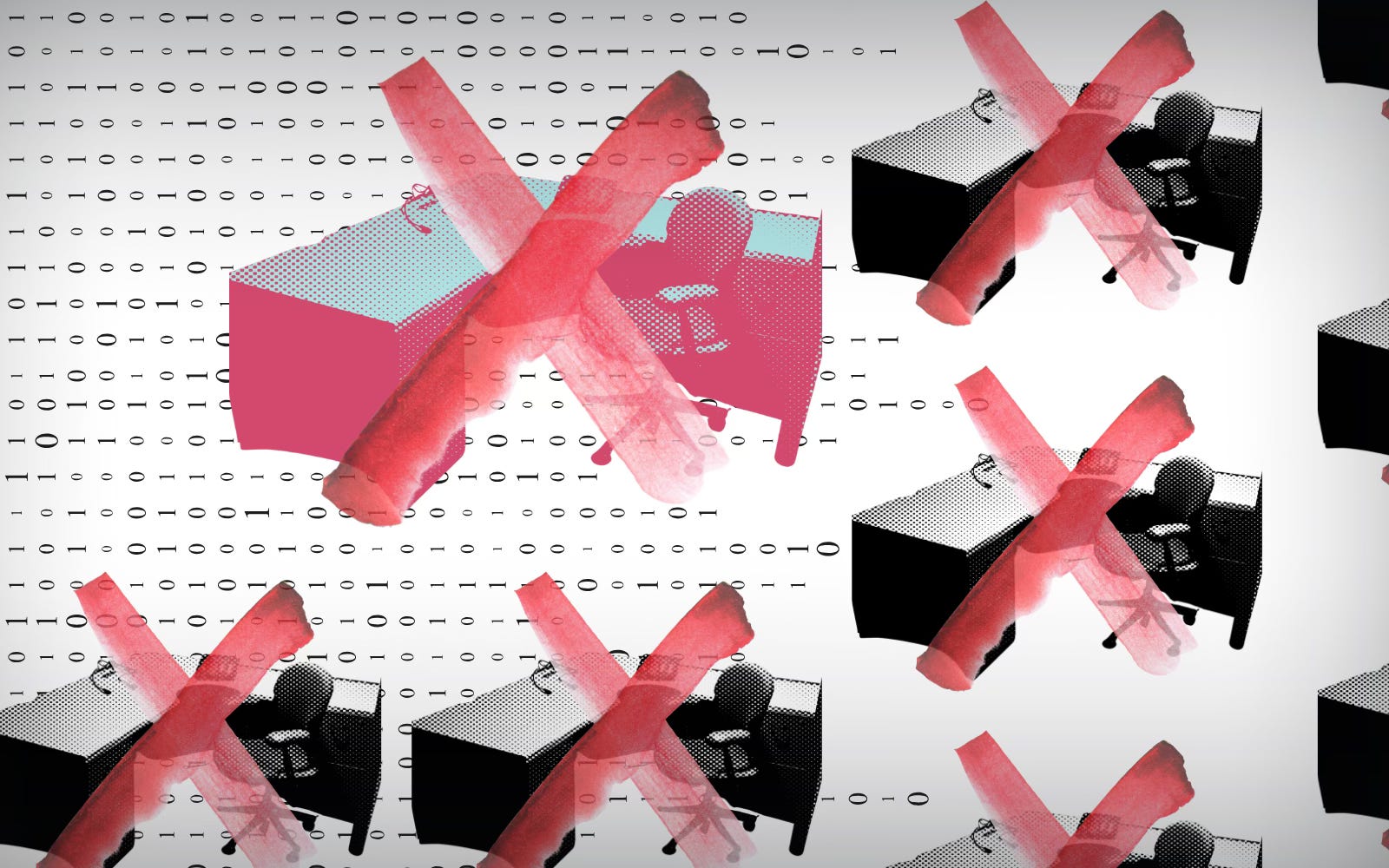
Inside the Vatican this past Monday, one of the world’s leading artificial intelligence executives delivered a warning that should have immediately reshaped the debate happening in Washington about health care and the future of work.
Anthropic cofounder Chris Olah warned that mass job losses caused by AI are “a real possibility” and that supporting displaced workers could become “a moral imperative of historic proportions.”
That warning carried additional weight because Anthropic CEO Dario Amodei has already made similar predictions publicly, cautioning earlier this year that AI could wipe out a substantial share of entry-level white-collar positions within the next several years. Taken together, the message coming from the people building these technologies has become increasingly difficult to ignore.
But while policymakers continue debating how artificial intelligence may change health care delivery itself — whether insurers will use it to accelerate denials, whether hospitals can automate administrative work or whether Medicare programs like WISeR will expand algorithmic oversight deeper into the system — they are largely ignoring another crisis quietly taking shape beneath the surface.
What happens to the American health insurance system if millions of Americans lose the jobs that provide their coverage in the first place?
Because in the United States, losing your job often still means losing your health insurance too. And our entire system remains dangerously dependent on the assumption that stable, full-time employment will continue to anchor access to health care in the decades ahead.
The American employer-sponsored insurance system was never really designed. It evolved almost by accident during World War II, when wage controls pushed employers to offer health benefits instead of higher salaries. Tax policy later cemented the arrangement into place and what began as a temporary workaround became the backbone of American health coverage. Today, nearly half of us receive health insurance through an employer. For decades, politicians treated that arrangement as proof of a uniquely American, market-based system but, in reality, it has never been a true free-market model. America’s health care system relies heavily on tax subsidies and ties access to health care directly to employment. That arrangement has been eroding for years, especially as small and mid-sized businesses struggle to absorb the constantly rising cost of coverage and AI may accelerate the unraveling.
Employer-sponsored health insurance has become extraordinarily expensive. Family premiums now approach $27,000 annually, according to recent Kaiser Family Foundation data and workers’ contributions have risen dramatically faster than wages or inflation. For many employers, health insurance is no longer simply a benefit offered to workers. It is one of their largest and fastest-growing expenses. That reality matters when discussing artificial intelligence because replacing a worker is no longer just about eliminating a salary. It also means eliminating the cost of that worker’s health coverage. The person sitting in the cubicle comes with premiums, deductibles, administrative costs and potentially a $27,000-a-year family health plan. The algorithm does not.
That creates an uncomfortable incentive few policymakers want to discuss openly. For years, employers have struggled under rising insurance costs driven by premium increases, administrative complexity and a system designed to maximize revenue rather than affordability. AI now offers many companies something more than efficiency gains. It offers an escape from one of their biggest financial obligations. And the workers most exposed to this disruption are often the very workers most likely to receive employer-sponsored insurance: office employees, analysts, claims processors, marketing staff, junior accountants and other white-collar workers whose jobs increasingly can be replicated or supplemented by AI systems.
Researchers already are beginning to see early signs of this shift. Major technology companies have reduced hiring of recent graduates and economists who once dismissed concerns about AI-related unemployment are now beginning to acknowledge the possibility of a labor market significantly disrupted. Some estimates project millions of workers may ultimately need to change occupations as automation spreads across the economy. The question is no longer whether AI will reshape the workforce but, instead, how disruptive that transition will be and whether our predominant system of health insurance will buckle.
Millions of Americans remain only one layoff away from losing coverage. Marketplace plans continue to become more expensive, Medicaid is or soon will become harder to qualify for in many states and high deductibles increasingly leave Americans with insurance unable to actually afford care when they need it. Even before AI eliminates a single job, the cracks in the system are already visible and folks are falling through them.
The future may not arrive as a sudden collapse. It may look more like slow erosion: fewer employers offering benefits, more contract and gig work, more Americans cycling between jobs, COBRA coverage, ACA Marketplace plans and periods without insurance altogether. The system was built around the assumption of stable, full-time employment, but that assumption is no longer guaranteed.
That being said, employer-sponsored health insurance has been in slow-motion decline for years, even if most policymakers continue pretending the system is functioning normally. The percentage of small employers able to offer subsidized coverage has steadily eroded under the relentless pressure of rising premiums and administrative costs. For many business owners, providing health benefits has become one of the single largest expenses they face. Health insurers continue raising costs while simultaneously shifting more financial burden onto workers through higher deductibles, narrower networks and growing out-of-pocket expenses, leaving many employees paying more for coverage that is worse than the previous year.
Every additional dollar employers are forced to spend just to maintain health coverage is money that often cannot go toward higher wages for workers. In many ways, the American health insurance system has quietly been consuming workers’ raises for decades, with employers and employees alike trapped in a cycle where coverage becomes more expensive each year while feeling increasingly less secure.
Meanwhile, the insurance industry itself is already positioned to adapt. Private insurers increasingly derive growth from taxpayer-funded programs like Medicare Advantage and Medicaid managed care. Companies such as UnitedHealth Group have spent years expanding into government-funded coverage while vertically integrating by buying or creating pharmacy benefit managers, physician practices, clinics and data services. If employer coverage weakens, the insurance industry will not disappear. It will simply shift where it extracts its revenue — increasingly from us as taxpayers.
Which raises the question Washington should be asking right now: What happens when the primary way Americans receive health insurance no longer aligns with how Americans work?
AI may improve medicine in important ways. It may reduce administrative burdens, help clinicians and speed certain aspects of care. But it is also exposing the deeper vulnerability in the American system that existed long before artificial intelligence arrived. We built our health insurance model around jobs. Now we are entering an era where the nature of work is changing by the day. And if policymakers wait until millions more Americans lose both their jobs and their health coverage before confronting that reality, it will already be too late.
The charity clinics overflowing in fairgrounds, school gyms and community centers across America are not scenes from some distant dystopian future. They are warning signs that have already been here before the system’s impending collapse. And they are telling us something important about the system we have built and how fragile it may become in the years ahead.
We are just going to have to follow the rest of the advanced world, and put in National Health, forgetting about the private sector which has "started" to show its predatory face. Of course, to do that we would have to arrest all the lobbyists (send them to GITMO). Parasites are a threat to health.
A well-reasoned and well-written piece. Thanks.