

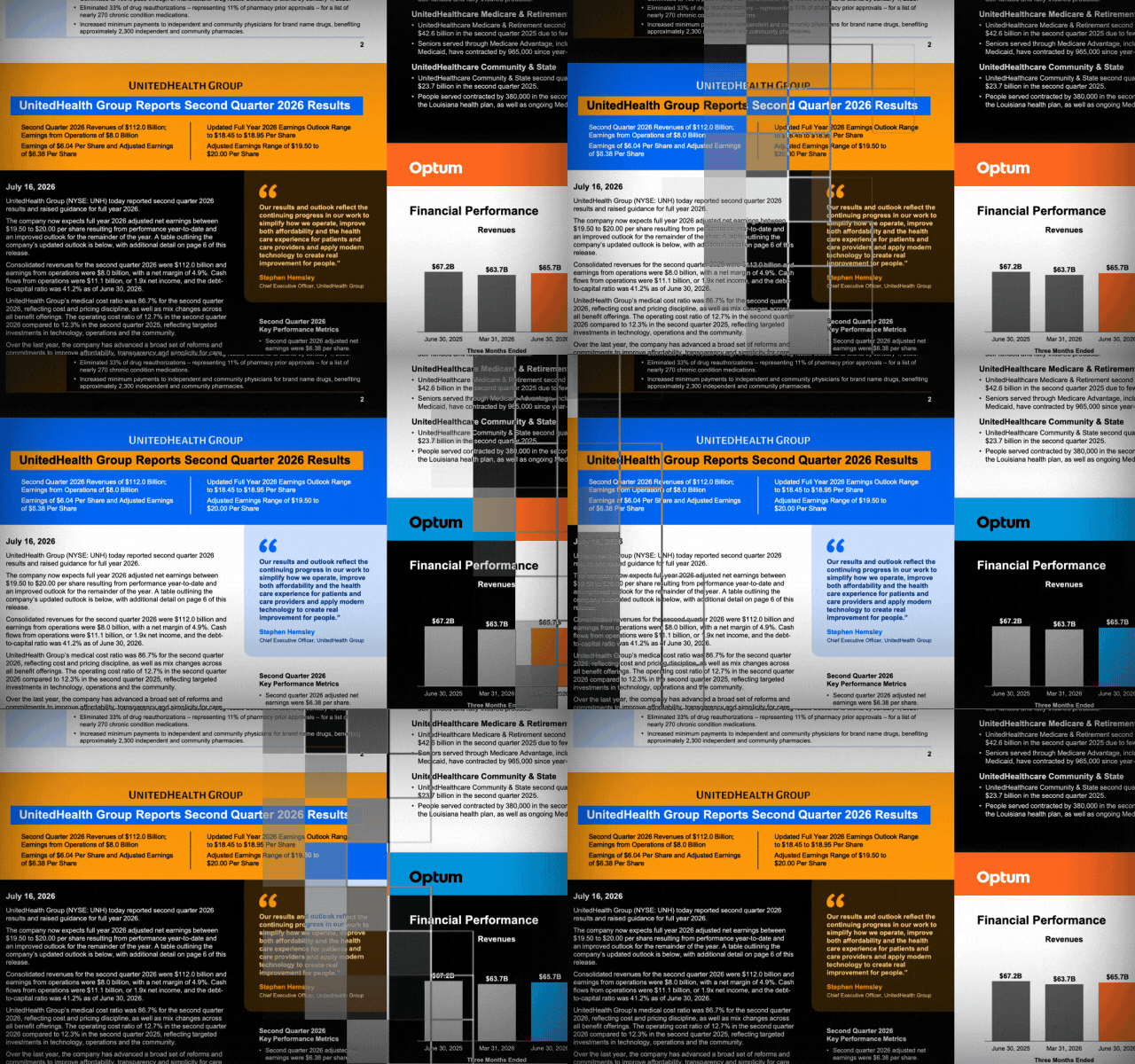
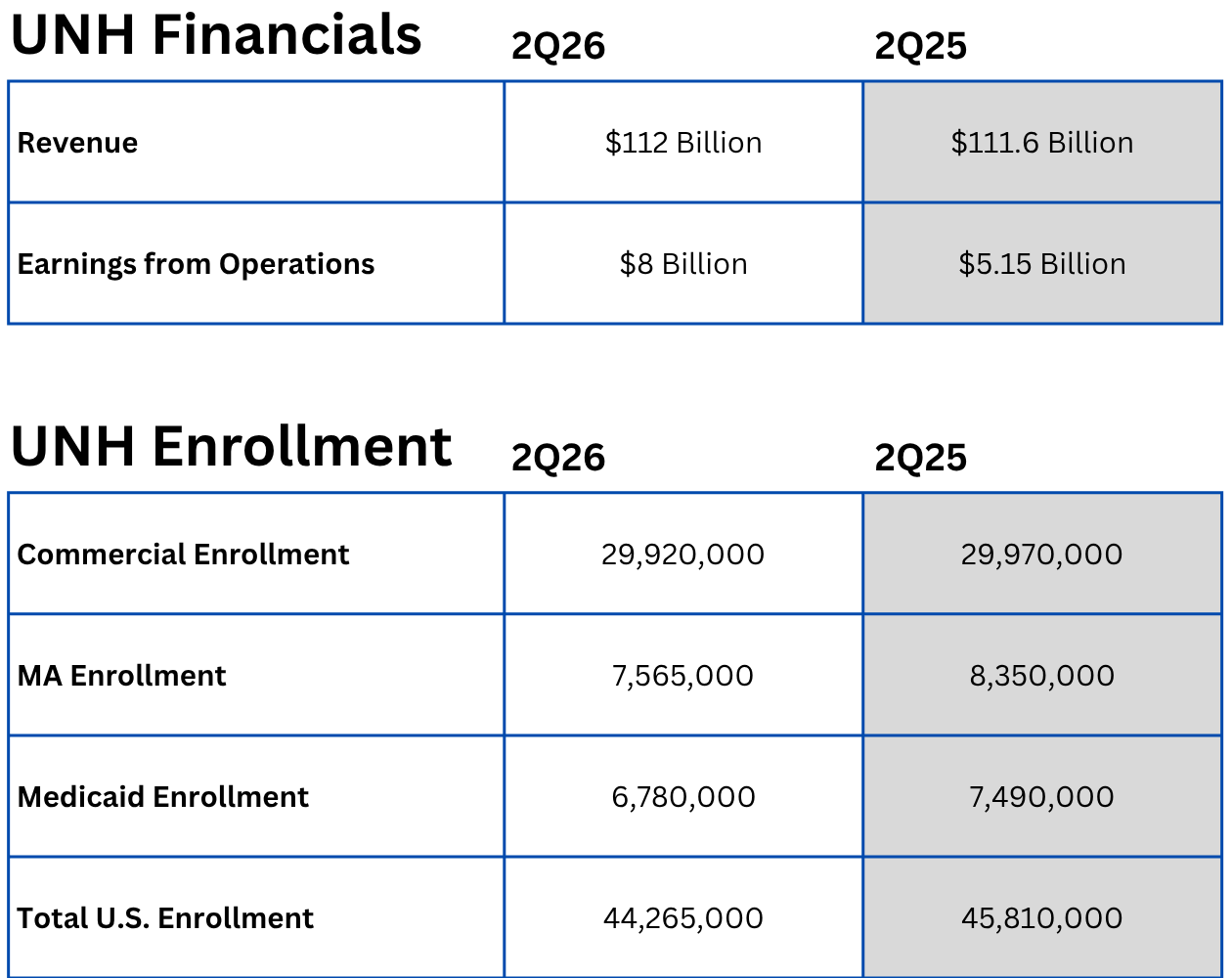
UnitedHealth Group, the country’s biggest health insurance conglomerate, wowed Wall Street last week when it announced that its profits increased a whopping 55% during the second quarter of 2026, from $5.2 billion at the end of 2Q 2025 to $8 billion in 2Q 2026. That puts the company on track to post profits for the year north of $30 billion. UnitedHealth achieved its impressive profit growth during the second quarter largely by:
shedding more than 1.5 million of its health plan enrollees and
spending a considerably smaller percentage of its customers’ premiums paying claims than it did in the same quarter last year.
The company also continued to take advantage of being able to pay itself with our premiums and tax dollars: The company spends more than one of every four dollars it collects in health plan revenue paying the thousands of physician practices and other clinical operations it has bought over the past several years.
Investors were so pleased with the company’s second quarter performance that they bought millions of UnitedHealth’s shares on Thursday and Friday, pushing the stock price up more than 10% at one point during the day on Thursday before settling at $423.38. Since the first of this year, UnitedHealth’s share price has increased more than 32%.
That number could soar higher if UnitedHealth and the other big insurers are able to change a law the industry helped write and lobbied heavily for: the No Surprises Act.
UnitedHealth’s executives implied that they’d be able to reward shareholders even more richly in the future if the insurance industry’s behind-the-scenes campaign to get Washington to tweak the NSA is successful. UnitedHealth could spend even less paying claims in the future, one of the company’s top execs said on the earnings call, if Congress would change the No Surprises Act in a way that would give insurers a big advantage in resolving payment disputes with doctors and other health care providers.
The No Surprises Act — the 2020 law that prohibited out-of-network hospitals and physician practices from balance-billing patients and that established an arbitration process to settle payment disputes between insurers and providers – has, according to UnitedHealth’s executives, turned out to be a driver of rising health care cost trends.
What the executives didn’t mention on the call was that UnitedHealth itself had spent considerable resources to fund research – which the industry and its allies used in its lobbying efforts – to persuade lawmakers that there was a need for the NSA. It quietly bankrolled and shaped the academic research that pushed Congress to act, court records show, and it did so precisely because it expected the law to hand insurers leverage over doctors and hospitals. But since the law went into effect in 2022, providers – not insurers – have prevailed in a majority of the payment disputes that have gone through the arbitration process. You can be sure that by spending several minutes on a once-a-quarter call with investors to villainize the NSA, UnitedHealth is funding an effort to “reform” the NSA in ways that would give insurers the leverage it had banked on.
What UnitedHealth told investors
On the July 16 call, Dan Kueter, who runs United’s commercial business, walked analysts through why medical costs in that segment are running “modestly above” 11%. His first culprit was neither hospital consolidation nor increases in prescription drug costs, both of which insurance executives have cited for years as the biggest drivers of “medical trend”. The new villain is the NSA.
“The ineffective IDR process that’s associated with the No Surprises Act is being exploited by select providers and select geographies,” Kueter said. “It’s contributing 50 basis points or so of incremental trend in 2026, now totaling at least 100 basis points of total cost.” [Interpretation: 100 basis points equals 1%. So Kueter was claiming that 1% of that 11% increase in medical costs is because health care providers have been winning too many of their payment disputes with the company. ]
IDR stands for Independent Dispute Resolution — the arbitration system Congress created so that when an insurer and an out-of-network provider can’t agree on a fair payment, a neutral arbiter decides, and the patient is kept out of the crossfire. It is the mechanism that makes the whole law work. Take away binding arbitration and “no surprises” becomes a slogan with nothing behind it.
Bought, Then Shuttered: What UnitedHealth Group did with the Behavioral Health Clinics it Acquired

The nation’s largest health insurer bought hundreds of community mental-health practice locations, then closed half of them within three years, largely out of public view.
Pressed later on the call by a Barclays analyst on why costs are climbing now, Kueter piled on. Citing insurance industry numbers, he said that up to 40% of claims entering arbitration are “ineligible” and that just five entities are involved in roughly 60% of cases. And the average arbitration payout, when the arbiter sides with the out-of-network provider, is “now eleven times what Medicare would pay, with some of those decisions ranging up to 30 times what Medicare would pay.” His conclusion: the process is not working, certainly not as Congress intended it, and it needs to be reformed.
Notice the framing. Providers who use a legal process to contest UnitedHealthcare’s payments are “exploiting” it. Arbiters who rule against the company are producing outlandish numbers. The reference point for what a doctor “should” be paid is Medicare — a rate UnitedHealthcare and the physician practices UnitedHealth owns – would not accept from commercial insurers. The company’s proposed fix: change the arbitration system that protects patients from balance bills in a way that would benefit health insurers and their shareholders.
What United did not mention on the call with Wall Street analysts is that when arbiters keep siding with providers by wide margins, the most obvious explanation – based on court records and research not funded by UnitedHealth – is not that the providers are greedy but that the insurer’s opening payment offers are often way too low. That is, after all, exactly what a Nevada jury concluded about UnitedHealth not long ago.
The study that influenced Congress
To understand why UnitedHealth’s new posture is so audacious, you have to go back to the research that got the No Surprises Act moving in the first place.
In 2016 and 2017, Yale health economist Zack Cooper was the lead author of influential studies on surprise billing, published by the New England Journal of Medicine.. They landed on the front pages of The New York Times, The Wall Street Journal and The Washington Post, and they framed the problem in a very particular way: The real culprits were private-equity-owned physician staffing firms — companies like EmCare and TeamHealth — that were driving up out-of-network charges. Congress cited the work as it built the case for the No Surprises Act.
Who's Really Gaming the No Surprises Act?

A new insurer-funded study casts doctors as the problem, even as insurers face allegations they coordinated to suppress out-of-network payments.
What almost no one knew at the time was who was behind the data. As The Intercept reported in 2021, drawing on internal emails pried loose in litigation, the studies were built on claims data handed over by UnitedHealthcare under an agreement that kept the insurer’s name out of Cooper’s New England Journal of Medicine article and the newspapers that reported on it. And UnitedHealthcare did not just supply numbers. Executives were briefed on the researchers’ progress, suggested edits, and, under the addendum to their data-use agreement, could even oppose publication if a paper wasn’t to their liking. One UnitedHealth president suggested policy language that made it into the study. A communications staffer wrote that the company’s support of Cooper was “expected to remain ‘behind-the-scenes,’” and that as the findings cast providers “under a less-than-positive light,” United would need to look at “further distancing ourselves from the piece.”
In other words, the marquee academic evidence that helped shape a federal law was quietly steered by the largest company with a direct financial stake in the outcome — a stake that ran in exactly one direction: portraying providers as the problem so that pressure would fall on them, not on insurers.
What a jury saw
In November 2021, a Clark County, Nevada jury ruled for three TeamHealth affiliates that had sued UnitedHealth over drastic underpayments. After more than three weeks of testimony, the jury found UnitedHealth liable for unfair reimbursement practices and — in language rarely attached to a Fortune 5 company — guilty of “oppression, fraud and malice.” It went on to assess $60 million in punitive damages on top of compensatory damages.
During the trial, John Haben, the former head of UnitedHealth’s Shared Savings Program, confirmed on the stand the company’s role in “colluding with Yale University professor Zack Cooper to produce a controversial study” — a study, in TeamHealth’s words, that “misled Congress into passing legislation giving insurers significant leverage over frontline providers.” Haben also testified that UnitedHealth paid as little as 20% of clinicians’ billed charges, while its Shared Savings Program collected an administrative fee of up to 50% of the difference between the billed charge and UnitedHealth’s payment — sometimes pocketing more on the fee than it actually paid the doctor.
A fix in search of a sponsor
For all of UnitedHealth’s talk about a law that “needs to be reformed,” there is, at the moment, no bill in Congress that would rewrite the No Surprises Act the way the company wants. The company’s wish list from the call — cap arbitration awards, anchor them to Medicare or to the insurer’s own “qualifying payment amount,” and choke off provider access to the dispute process — exists only as advocacy and op-eds, not as introduced legislation with anyone’s name on it.
Big Insurance Q1 2026 Earnings Round Up

In Q1 2026, 7 Big Insurers did what their shareholders demanded: hike premiums, slash benefits and dump the sick.
In fact, the only NSA-specific bill moving on Capitol Hill cuts the other way. The No Surprises Act Enforcement Act — led by Representative Greg Murphy, a North Carolina Republican and physician – and its Senate companion, led by Senators Roger Marshall (R-Kan.) and Michael Bennet (D-Colo.) — would penalize insurers that fail to pay providers promptly after losing an arbitration. It targets precisely the slow-pay, underpay behavior a Nevada jury already punished UnitedHealth for. And the most recent federal action went against the insurers too: the Trump administration’s IDR rule, finalized in May, cut the arbitration filing fee from $115 to $15, making it easier, not harder, for doctors to challenge lowball offers. That rule, along with the NSA Enforcement Act, is likely part of why United is escalating now.
What United has instead of a bill is a pressure campaign. In February, the ERISA Industry Committee organized a letter to the Treasury Department and the Departments of Labor, and Health and Human Services, signed by more than 60 groups and billed as the voice of “employers, workers, patients, consumers, and brokers.” It urged regulators to force arbiters to anchor their decisions to something called the qualifying payment amount (QPA) and to carve elective procedures out of the dispute process — UnitedHealth’s ask, almost verbatim. The letter singled out four provider groups as the villains overwhelming the system, first among them TeamHealth, the company that won the “oppression, fraud and malice” verdict against UnitedHealth in Nevada.
UnitedHealth’s own name is not on that letter, and I haven’t found any evidence it drafted or funded it. But the “employers and patients” framing obscures who else did sign it. Among the signatories are several other big insurers, including Elevance Health, Blue Shield of California, Blue Cross Blue Shield of Michigan, and Point32Health. The insurer position, in other words, was carried into the administration under a consumer-friendly banner and built on the same body of research that United helped set in motion a decade ago.
The February letter was organized by the ERISA Industry Committee, a lobby for large employers, which are big insurers’ biggest customers. Weeks later, in March, STAT News ran an opinion piece headlined “Congress must fix the No Surprises Act before it bankrupts patients and employers.” Its lead author was James Gelfand — the ERISA Industry Committee’s president and CEO. The op-ed leaned in turn on a survey from AHIP, the insurance industry’s own trade association, for its claim that 40% of disputes are ineligible. A coalition letter, an “independent” op-ed, and an industry survey that all sound like a grassroots cry for affordability but that trace back to the same small circle of insurer-aligned advocates. It is the 2016 playbook running again: let the argument arrive wearing someone else’s clothes.
Consider whose affordability is actually being defended here. The ERISA Industry Committee is the leading champion of the employer-based coverage system — but that system is quietly collapsing for the people who can least afford it. In an investigative report for STAT News earlier this month, veteran reporter Bob Herman documented that fewer than 60% of employers with 200 or fewer workers now offer health insurance, an all-time low, and that the share of working-age adults covered through a job has slid from 67% in 1998 to roughly 60%. Small businesses and sole proprietors are absorbing cost increases approaching 18 to 20% this year while the biggest employers see less than half that. When ERIC invokes “affordability,” it is speaking for its large corporate members, not the small employers being priced out of the market entirely — and clawing back arbitration awards does nothing for the latter. Here is the quieter truth underneath it all: most large employers are self-insured, which means the employer’s own money pays the claims while UnitedHealth and its Optum arm collect administrative fees on top, win or lose at arbitration. The Nevada trial showed how lucrative that machinery can be — UnitedHealth’s Shared Savings Program skimmed up to 50% of the gap between billed charges and its own payments on out-of-network claims, money drawn straight out of those employer plans. UnitedHealth does bear real risk on its fully insured commercial business, and higher arbitration awards genuinely pinch those margins; that is the complaint Kueter aired for investors. But on the far larger book of employer plans it merely administers, the company profits from the same out-of-network churn it now calls unaffordable. The campaign to gut IDR serves both hats at once.
Losing in court, too
The lobbying campaign has a courtroom twin, and it is faring no better. Unable to persuade arbiters to rule their way, insurers have turned to federal judges, filing a wave of fraud and racketeering suits against HaloMD — a firm that represents providers in arbitration — and the physician groups it works with, alleging they flooded the system with ineligible disputes and inflated offers to rig the outcomes. It is the same story UnitedHealth told its investors, dressed up as a legal complaint. And judge after judge has thrown it out.
In April, a federal court in California dismissed Anthem Blue Cross’s case against HaloMD. Days later, a Florida court tossed Aetna’s fraud suit against Radiology Partners. In May, a Texas court dismissed Blue Cross Blue Shield of Texas’s nearly identical complaint. Then, on July 10, Judge Thomas Thrash Jr. of the Northern District of Georgia dismissed with prejudice a suit by Blue Cross Blue Shield of Georgia — another Elevance company — ruling that the racketeering, ERISA, and state-law claims were improper “collateral attacks” on binding arbitration awards. Rather than “a vast conspiracy of providers and IDREs” defrauding the company across thousands of cases, Judge Thrash wrote, “it is highly plausible to infer that the Plaintiff engages in a consistent practice of submitting lowball offers to out-of-network providers in an effort to maximize its profits.” That is almost verbatim what the Nevada jury found about UnitedHealth four years earlier. Elevance says it will appeal, and more suits — including one from UnitedHealth in Pennsylvania — are still pending.
Here is the through-line UnitedHealth would prefer investors and policymakers not connect. The company wanted a surprise-billing law because it believed the law would discipline providers and lower what UnitedHealth had to pay them. It got the law. Then providers used the law’s arbitration process — the one guardrail that keeps the fight away from patients — and started winning, because UnitedHealth’s offers were low enough that neutral arbiters kept ruling against the company. So UnitedHealth now says the arbitration process is broken and must be “reformed.”
It isn't the arbitration system that needs reforming. We need Medicare for All. A system that makes profits by denying care is backward. Preventive care and keeping people well should be the goal, not profits.
Until Citizens United becomes history, those with the most money will game the system and thrive while the suffering of 99% will increase.