

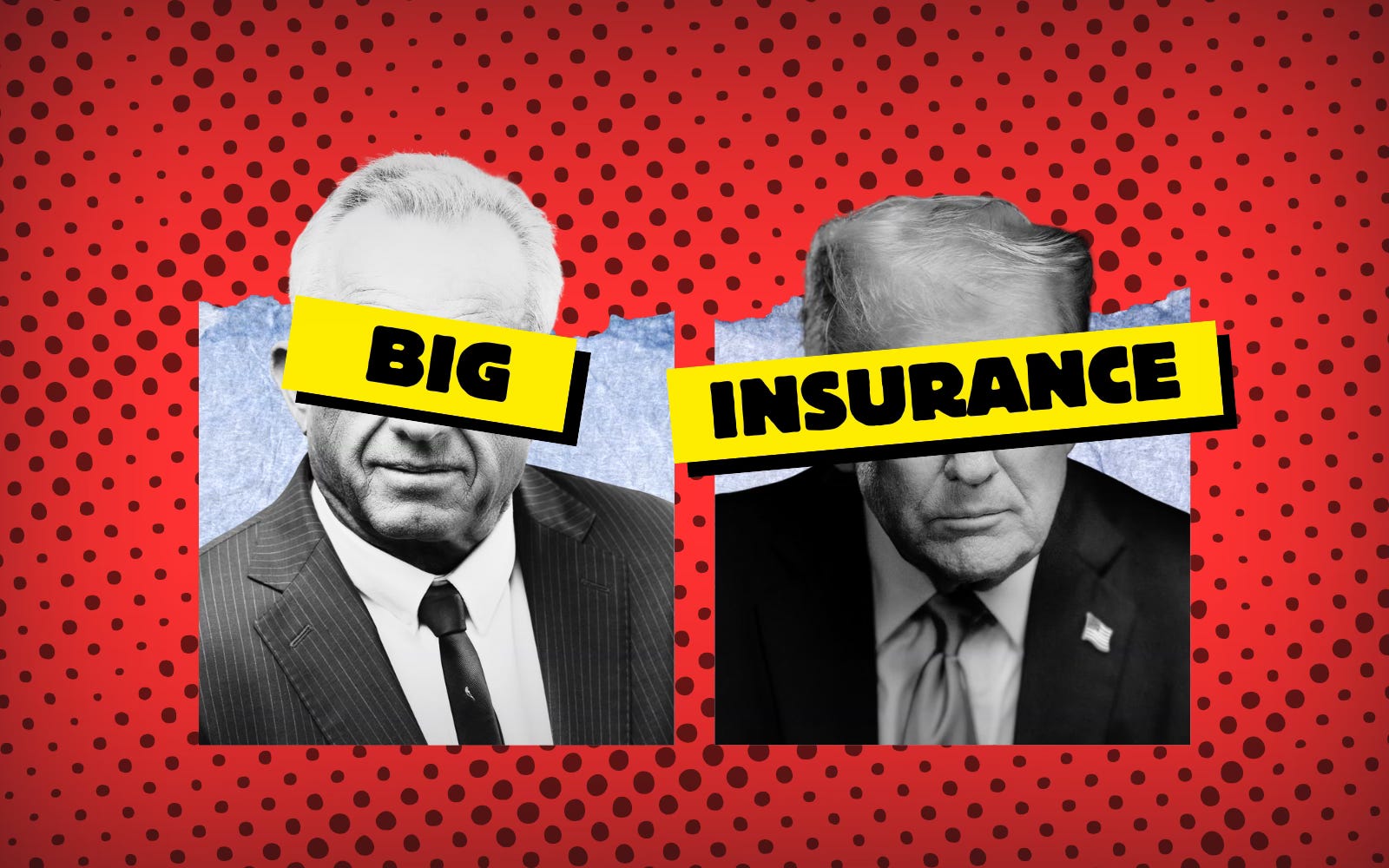
The MAHA movement built its brand on fighting corporate capture. Its big Washington summit is bankrolled by the companies it claims to fight, including two of the country’s largest health insurers and the AI giants now reshaping how care gets approved and denied.
In the past year, President Trump has spent a lot of energy attacking health insurers. Last November he told Senate Republicans to take money away from the “money sucking” and “BIG, BAD Insurance Companies,” and weeks later he swore the only health care he’d approve was one that cut out the “BIG, FAT, RICH” insurers who had ripped off America long enough. In December he vowed to summon insurance executives and make them slash prices. When he did, AHIP’s chief executive, Mike Tuffin, pushed back, saying premiums simply reflect the cost of care. Remember that name. Nine months later, Tuffin has a seat on a MAHA summit panel, and his industry is helping pay for the event.
On September 29, Robert F. Kennedy Jr.’s Make America Healthy Again movement is scheduled to hold a summit in Washington. POLITICO reports that the sponsors footing the bill include Walmart, OpenAI, and Anthropic. One panel features executives from UnitedHealth and Elevance, two of the largest for-profit insurers in the country. Alongside them sits Tuffin, who leads the industry’s top lobbying group in Washington.
Sponsors do not just get their names on a banner; they get a private dinner with the summit’s speakers. Those speakers include senior officials from the Department of Health and Human Services. So the companies with business before Kennedy’s department can buy an evening with the people who regulate them.
Trump Plans Meeting With Health Insurance Executives

The President says he’ll meet with health insurers as the 24 million people who buy coverage through the ACA marketplaces are now facing premium hikes large enough to push them out of coverage.
MAHA’s whole pitch is that industry poisoned Americans for profit and captured the agencies meant to protect them. Now the movement is selling access to said industry. A MAHA supporter quoted by POLITICO said it plainly. This is not fighting corporate capture. This is corporate capture.
For all his harsh words, Trump’s administration is comfortable sharing a stage with UnitedHealth, Elevance, and AHIP. And the contradiction goes beyond who gets a seat at the table. Just last week, Trump said, “We will stop all payments to big insurance, and give the money directly to the people.” (He made that same unworkable promise earlier this year.) But shortly after that promise, he essentially did the opposite. After initially proposing to keep Medicare Advantage payments mostly flat for 2027, his administration reversed course and finalized a significant increase worth more than $13 billion in additional payments to Medicare Advantage plans. So when Trump says he wants to “stop all payments to big insurance,” know that his administration very recently handed Big Insurance billions more.
The rhetoric is populist, but the guest list sure is not. If Democrats have been telling themselves the president’s insurer-bashing is just talk, this summit is the proof. It is also an opening, if they are willing to take it.
We have seen this movie before, and it is worth being clear about what it did and did not accomplish. In January, the CEOs of the five biggest insurers, UnitedHealth, CVS, Cigna, Elevance, and Ascendiun, were called before two House committees and made to answer for premium hikes, denials, and the way vertical integration has swallowed the industry. Some of the questioning was as sharp as anything these executives have faced in public.
Big Insurance CEO Hearings: 5 Clips to Watch

One Republican lawmaker, Rep. Greg Murphy, said that he wished he could turn the health insurers “into dust.”
Rep. Greg Murphy, a North Carolina Republican and a physician, told them they had put profits above patients and above the people who care for patients. He described his own eight denials trying to get a medication he needed after brain surgery, and said the average American would have just given up, which he argued is exactly what insurers count on. Rep. Alexandria Ocasio-Cortez pressed the CEO of CVS on the fact that his company owns the insurer, the pharmacy, the clinics, and the pharmacy benefit manager that controls close to a third of the prescriptions filled in this country. When he called that a model that works well for consumers, she answered that it works very well for CVS.
Murphy and Ocasio-Cortez could not be further apart on most things, and both meant it. So did the members who called the insurers’ conduct unconscionable and criminal to their faces. The problem is not the people who spoke up. The problem is what happened next, which was nothing. The hearing ended, the cameras left, and the industry went back to work. No law changed. No executive paid a price. The stock dip healed within days.
Everyone in Washington gets a turn looking tough on insurers, a Truth Social broadside from the president, a viral hearing moment from a member of Congress, a promised meeting that never happens. None of it costs the industry anything, because the thing that actually moves a company, its money and its access, keeps flowing in the other direction the whole time. The outrage is bipartisan. So is the capture.
My team built a tool to explain how that capture happens: the Health Insurance Influence Tracker, a project of the Center for Health & Democracy, which I lead, shows where the industry’s political money actually goes. And the checks go to both Republicans and Democrats. You can look up your own members of Congress and see for yourself.
Big Insurers Are Pouring Millions Into the 2026 Midterms

The Health Insurance Influence Tracker (HIIt) shows insurers are on pace to surpass recent campaign spending, with donations targeting leaders and key lawmakers in both parties.
So I want to put a question to every candidate running this cycle, in both parties. Will you refuse money from the health insurance industry, and will you return what you have already taken this cycle?
If you believe the industry is gouging your constituents, you should not be cashing its checks while you say so. The tracker will show who is willing to draw that line and who is not.
Trump showed the country that words are cheap, and the MAHA summit shows that access is for sale. The least the rest of us can do is follow the money, in both directions, and ask the people who want our votes to choose a side.
Draining the swamp? Not.
The private dinner is the detail that turns sponsorship into a governance question. Transparency should cover access itself, including who met regulators, in what setting, and what issues were discussed, rather than ending with a sponsor list.