

Only a few months after Congress enacted some of the most significant federal reforms to date of the business practices oft pharmacy benefit managers, the PBM industry’s chief lobbying group says it has launched the biggest advertising campaign in its history.
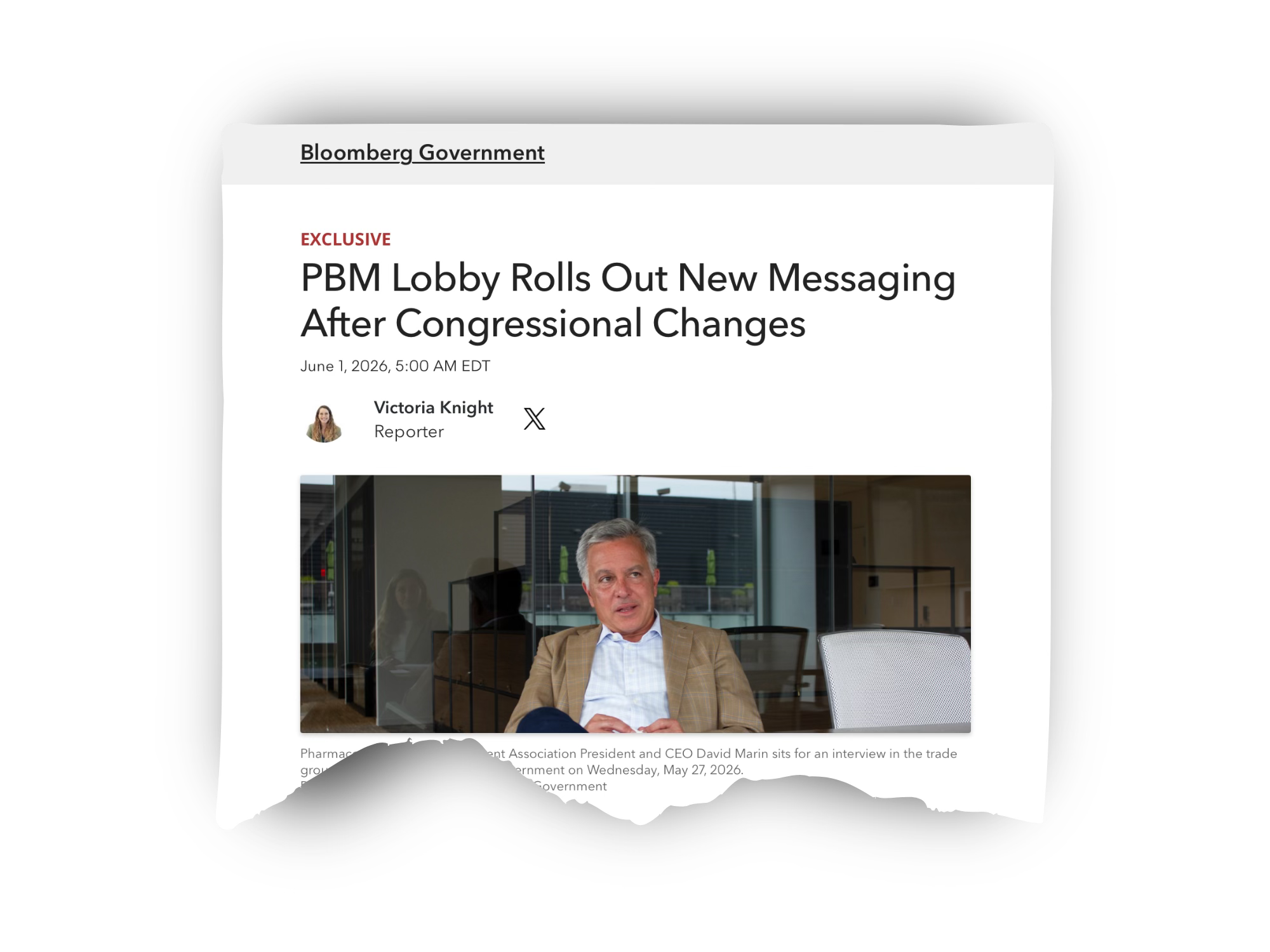
The largest PBM trade group in the nation, the Pharmaceutical Care Management Association (PCMA), is now spending millions of dollars trying to convince Main Street and Pennsylvania Avenue that PBMs are misunderstood. According to Bloomberg Government, PCMA’s new CEO, David Marin, acknowledged that the industry has failed to explain its value and that some of the reforms Congress enacted were necessary. He said PBMs had been “too reactive, too passive, and often too late to the game.”
It’s the exact type of shallow-admission that you would expect from an industry trade group trying to buy goodwill in Washington and state capitals.
For years, PBMs and their lobbyists insisted that critics simply didn’t understand how the prescription drug supply chain worked. Whenever patients complained about rising costs, pharmacies complained about reimbursement practices or lawmakers raised concerns about conflicts of interest, the industry’s response has always been something along the lines of “But PBMs save money and everyone else is to blame.”
Earlier this year, lawmakers enacted reforms requiring greater transparency, new rebate pass-through requirements, and changes that prevent PBM compensation in Medicare Part D from being tied to drug prices and rebates – essentially telling the industry its explanations (or excuses) are no longer sufficient. And as I wrote earlier this year, those reforms are important but they’re only the tip of the iceberg.
If PBMs were already operating in a way that consistently benefited patients and employers, why were these reforms necessary in the first place? The answer may have something to do with the extraordinary concentration of power in the PBM market via Big Insurance’s vertical integration into virtually every aspect of health care.
Today, three companies — CVS Caremark, Express Scripts, and Optum Rx — control roughly 80% of prescription drug claims in the United States. Federal regulators have warned that this concentration, combined with extensive vertical integration throughout the health care system, gives a small number of corporations enormous influence over what drugs patients can access, where they can fill prescriptions, and how much they ultimately pay.
The Five Revenue Streams That Run Through Every PBM Contract — and Five Needed Reforms

PBMs generate revenue from multiple sources simultaneously, allowing profits to shift from one channel to another whenever reforms target a single practice.
CVS Caremark is part of CVS Health, which also owns Aetna. Express Scripts is owned by Cigna. Optum Rx is owned by UnitedHealth Group. Each is embedded within a larger health care conglomerate that also operates insurance businesses and other health care subsidiaries. In many cases, this elite few corporations influence multiple parts of the health care transaction simultaneously – all “in-house”.
That level of consolidation (which my team at the Center for Health & Democracy highlighted last summer in the Sunlight Report on UnitedHealth Group) has attracted increasing scrutiny from policymakers, regulators, employers, pharmacists and patient advocates.
Last year, the Federal Trade Commission released findings from its ongoing PBM investigation, concluding that the largest PBMs may be using their market power and vertical integration to inflate costs and disadvantage independent pharmacies. A subsequent FTC report found that the three largest PBMs generated billions of dollars in revenue through large markups on specialty generic drugs dispensed through affiliated pharmacies. The agency reported that these practices generated more than $7 billion in excess revenue between 2017 and 2022.
In September 2024, the Federal Trade Commission sued those three giant, vertically integrated PBMs and alleged that their rebate practices artificially inflated insulin prices and restricted access to lower-cost alternatives. According to the FTC, the PBMs favored high-list-price insulin products that generated larger rebates even when lower-cost options were available, creating what the agency described as a system that increased costs for patients while enriching intermediaries.
The case was significant not only because it targeted the industry’s three dominant players, but because it challenged one of the PBM industry’s central claims—that its business model consistently lowers drug costs. Since the lawsuit was filed, Express Scripts has reached a settlement with the FTC, and both CVS Caremark and Optum Rx have entered settlement discussions with the agency.
Hulu’s Futurama Gets the Insurer-Physician-PBM Scheme Right

Cartoon satire nails the vertical integration of health care giants like UnitedHealth Group, Cigna and CVS/Aetna.
As I’ve written previously, the scrutiny facing PBMs is not confined to Washington. In recent years, lawmakers in states as politically diverse as Alabama, Arkansas, California and North Carolina have advanced bipartisan reforms aimed at curbing PBM practices, protecting independent pharmacies and restricting conflicts of interest. Last year alone, dozens of states enacted some form of PBM reform – suggesting that the industry’s problem is not simply that Americans misunderstand PBMs, but increasingly, lawmakers who have examined the industry’s business practices understand them all too well.
In closing
What is clear about PCMA’s new advertising campaign is that it appears to recognize a political reality that the industry spent years denying. Congress and states did not enact major reforms because PBMs were winning the public relations battle. Congress and states enacted reforms because lawmakers in both parties increasingly concluded that the PBM business model deserved greater scrutiny and accountability – especially since independent pharmacies began raising the alarm.
I’m sure that inside PCMA’s Penn Quarter office, which is about halfway between the White House and the U.S. Capitol, they know the national and local scrutiny is unlikely to disappear simply because the industry’s advertisements have a new tagline. And that’s kind of the point. This isn’t a campaign to change the behavior of PBMs or encourage their members to put patients ahead of profits. It’s a campaign to change the conversation and convince lawmakers walking through Washington’s Union Station that the industry’s image problem is merely a messaging problem.
Big health insurers are using Washington-based trade group the Pharmaceutical Care Management Association (PCMA) to bankroll ad campaigns in the DC area

Health insurers are using the PCMA to protect their expanding profits in the pharmacy supply chain.
If PCMA truly believes its problem is one of public misunderstanding, it has certainly devoted substantial resources to changing the narrative. According to OpenSecrets, PCMA spent nearly $18 million on federal lobbying in 2024, up from approximately $15 million in 2023 and roughly double what it spent just two years earlier. The organization spent much of that money fighting bipartisan proposals that would have reformed PBM compensation and business practices.
At its core, this campaign is an attempt to recast a crisis of accountability as a crisis of communication. Americans are being asked to believe that lawmakers, regulators, pharmacists, employers and patients all reached the same – but wrong – conclusions and that the real problem is simply that PBMs haven’t told their story effectively enough. That explanation might be more convincing if Congress hadn’t just enacted major reforms, if states across the political spectrum weren’t pursuing their own crackdowns, and if federal regulators weren’t actively investigating the industry’s largest players.
Optum has been sponsoring NPR's Marketplace program recently and does not mention its parent company, UnitedHealth Group.
Excellent 👌 Wendell