

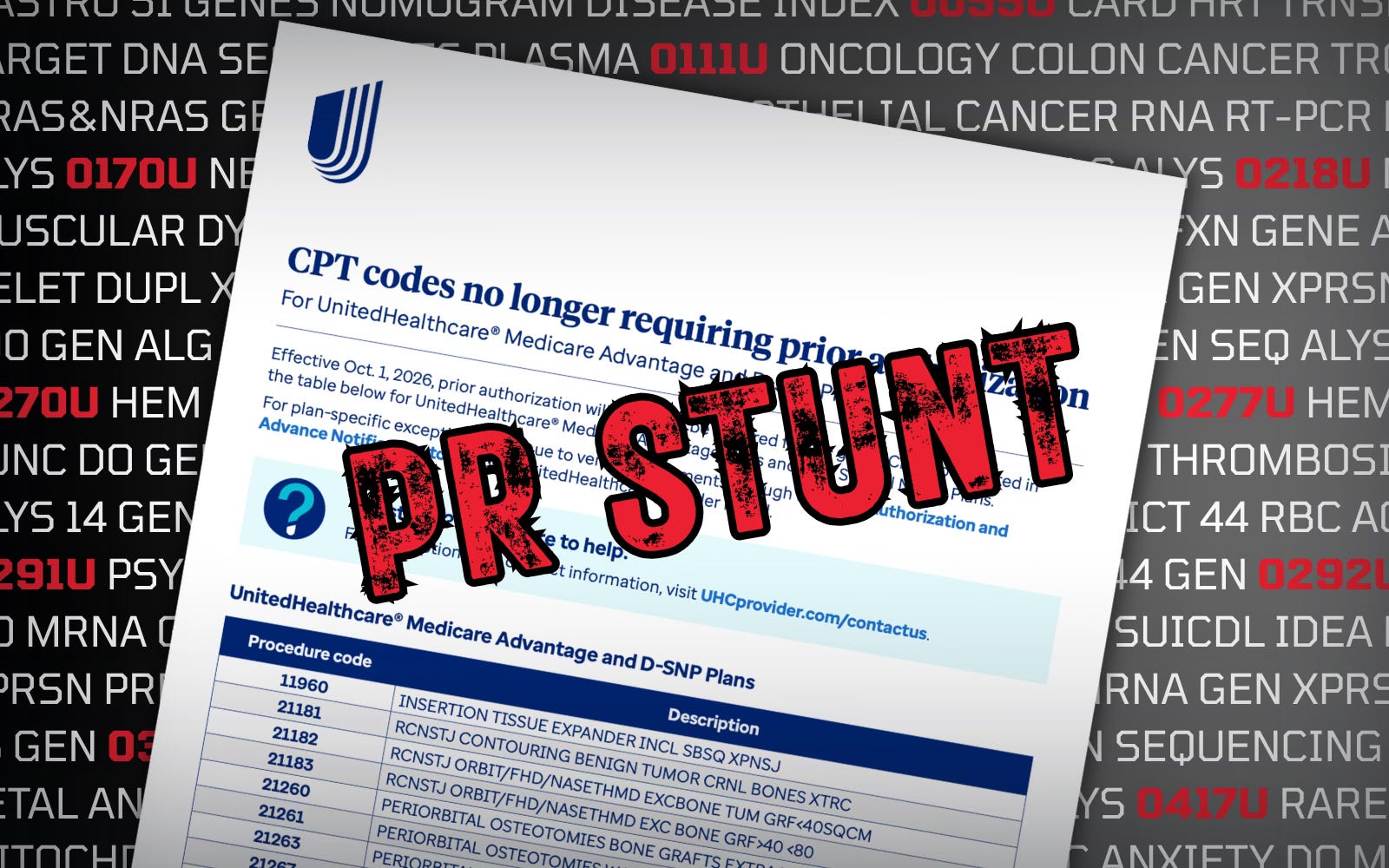
UnitedHealthcare, the subsidiary of the massive parent company UnitedHealth Group, announced that it will eliminate prior authorization requirements for roughly 1,700 medical procedure codes beginning next month, a move the nation’s largest health insurer says will cut its prior authorization requirements by 30%.
The changes reportedly will apply across its commercial, Medicare Advantage, Medicaid, individual exchange and Oxford plans. UnitedHealthcare says the move will reduce administrative work for doctors and remove barriers that can delay care for patients.
Health insurers know they have a PR problem on their hands amid mounting scrutiny from patients, doctors, lawmakers and regulators. To try to make that PR problem go away, the industry has increasingly promised to make prior authorization faster, simpler and less burdensome. And this latest pledge by UnitedHealth seems like nothing more than a PR trick to me.
Their pledge deserves a closer look. And I’m just the guy for the job.
More is less
The company says the move will reduce its prior authorization requirements by 30%, eliminating red tape for doctors and removing barriers that can delay care for patients. Thirty percent sounds like a lot but, if the company is to be believed, that currently applies to only about 2% of the medical services it covers (by the company’s own accounting).
So UnitedHealthcare isn’t eliminating prior authorization for anything close to 30% of medical care. By its own numbers, it is removing the requirement from roughly six-tenths of one percentage point of all medical services.
Factually speaking, that’s not nothing, but it certainly makes for a less impressive reality than the press release leads on. The other thing to keep in mind is that that 2% figure undoubtedly covers the treatments and medications that are the costliest and most important to the continued health and well-being of patients. In other words, the ones that often mean the difference between life and death. In that regard, the 2% figure is an example of a trick I used to use and that is prevalent in the PR trade: using an impressive-sounding number to mislead by obscuring other important information and data.
Double counting
I reviewed UnitedHealthcare’s published lists of codes across its commercial, Medicare Advantage and D-SNP, Medicaid, individual exchange and Oxford businesses. What I, and other media outlets, found was apparent duplication.
UnitedHealthcare’s document contains about 70 distinct codes, but it prints those same codes twice, once under “Medicare Advantage and D-SNP Plans” and again under “Dual Special Needs Plans.” The individual exchange list, meanwhile, overlaps heavily with the commercial list. And many of the same codes appear again and again across UnitedHealthcare’s 17 state-specific Medicaid lists. So “1,700 codes” does not appear to mean 1,700 different medical services. It appears to be a tally of entries spread across numerous plan and state lists, with the same codes sometimes counted multiple times.
Our review suggests the actual number of unique CPT and HCPCS codes affected could be closer to 800 to 1,000. If UnitedHealthcare has a different number, it should release the deduplicated list.
Cheap codes
While some of the changes are meaningful – like for certain spinal procedures, joint surgeries, EEG monitoring, gastrointestinal procedures and durable medical equipment – the lists also include minor procedures, hearing-aid accessories, routine injections and a large number of “unlisted procedure” codes, essentially catch-all codes used when there isn’t a more specific billing code for a service. And many of the codes appear to be ones that are rarely, if ever, used by health care providers. Including them boosts the number of codes that will no longer be subjected to prior authorization.
Meanwhile, many of the categories at the center of the prior authorization controversy are largely missing: specialty and injectable drugs, GLP-1 medications, most oncology drug regimens and many cardiac device implants. In other words – yes – UnitedHealthcare is giving up some prior authorization requirements but not the ones that matter most to its bottom line.
And there’s another wrinkle UnitedHealthcare doesn’t exactly highlight in its announcement: While it is eliminating some prior authorization requirements beginning Oct. 1, it is also adding new ones. The company is adding prior authorization requirements for certain genetic and molecular testing codes effective that same day and has separately announced a new prior authorization requirement for an oncology code. So Oct. 1 isn’t simply about UnitedHealthcare eliminating red tape. While some requirements disappear, others are being added.
Health insurers do this type of thing (often)
Earlier this year, CEO Stephen Hemsley announced just before testifying before Congress that UnitedHealth would “voluntarily eliminate and rebate” its 2026 Obamacare profits to customers. As we explained at the time, what sounded like remarkable generosity was, in reality, a load of PR crap to generate favorable headlines about the company ahead of potentially embarrassing questioning on Capitol Hill.
UnitedHealth Group’s PR Stunt Disguised as Generosity

CEO Stephen Hemsley’s well-timed Obamacare rebate promise is mostly smoke, mirrors and an attempt to squeeze the company’s rivals.
That pledge fell short because UnitedHealth’s Obamacare business represents a tiny (and diminishing) fraction of its overall business. Even Wall Street analysts concluded that giving up those profits would not have a material impact on the company’s financial results. One analyst even called the move a potentially “masterful chess move” that could put pressure on UnitedHealth’s smaller competitors. The profits it might be giving up likely will be considered part of the cost of paying the PR firms the company likely has on retainer.
Cigna has played this game, too. In 2023, the company announced with considerable fanfare that it was eliminating prior authorization requirements for more than 600 medical services, describing the move as a nearly 25% reduction. But like this latest announcement from UnitedHealth, buried beneath that impressive-sounding percentage was that prior authorization applied to less than 4% of medical services for most of its customers in the first place.
Other insurers have made similar promises, with the industry’s Washington, D.C.-based PR and lobbying group, AHIP, saying many of its members have eliminated prior authorization requirements for millions of requests.
I know this playbook because I used to be part of it. During my years as a health insurance executive, we knew how to take a relatively small change and make it sound much bigger than it really was. Announce an impressive percentage or talk about reducing barriers for patients and doctors. It was all just to generate headlines about corporate responsibility, stave off reforms in Washington and give ammunition to our allies in the media.
It’s a classic example of lying with statistics. The numbers themselves don’t necessarily have to be false. You just present them in a way that leaves people with an impression that is far more flattering than the underlying facts.
Let’s wrap this up
To be clear, eliminating unnecessary prior authorization is a good thing. Doctors shouldn’t have to waste their time asking an insurance company for permission to provide care that a patient needs.
But before we congratulate UnitedHealthcare (a subsidiary of a company that made $12 billion last year) for eliminating “30%” of prior auths, it should tell us exactly how many unique services are affected, how many of its members will actually benefit and whether it will release enough data for the public to verify that these promises are being kept.
Until then, UnitedHealthcare’s 30% reduction looks a lot bigger in a press release than it does on planet Earth. And there are still plenty of things we don’t know about UnitedHealth’s little ploy – so here is what I’d ask them:
How many unique CPT/HCPCS codes are affected once duplicates across the five plan lists and 17 state lists are removed — is it really 1,700, or closer to 800–1,000?
Does this change apply automatically to self-funded/ASO employer plans, or only to UnitedHealthcare own fully insured products (which comprise a small fraction of the company’s total health plan enrollment)? What share of UnitedHealthcare’s self-funded clients have adopted it?
Why does the Community Plan/Medicaid list of 17 states not include other states where UnitedHealthcare operates Medicaid MCOs?
Will UnitedHealthcare publish a list of codes still requiring prior authorization after Oct. 1, and the total unique count?
Will UnitedHealthcare publicly report code-specific claims/denial data after Oct. 1 so outside parties can confirm the change is holding?
Will UnitedHealthcare open its books to an independent auditor so that we can be sure they’re telling us the truth? If not how — and why — should we believe the company.
As I wrote above, we’ve seen health insurance companies become remarkably good at turning relatively modest changes to their own business practices into sweeping declarations of corporate responsibility and getting public officials, like CMS Administrator Mehmet Oz, to praise the industry for its voluntary actions. (It’s a great way to reduce the heat and tamp down the political rhetoric as it tries to persuade lawmakers that new laws to crack down on abusive business practices are not necessary.) But until we actually know the details, this just seems like the latest example of UnitedHealth manufacturing a bit of good press and asking folks to applaud it for loosening a few restrictions that it erected in the first place.
So CMS and private for-profit and commercial health insurance industry considers RICO (racketeer influence, and corrupt organization) as a chess move?
Thanks for an edifying column, Wendell. I'm curious as to how many transactions and what kinds of transactions these codes apply to. For example, if code A is submitted for prior authorization 1 million times a year in United plans and code B is submitted 10 times a year, eliminating the first from prior auth requirements makes a bigger difference than eliminating the second. Also, if code A prior auth requests are rejected at a rate of 90%, eliminating it from prior authorization requirements has more impact that if the rejection rate is 5%. Are these data points knowable? Or, more likely, do the corporations call them proprietary?