

If your feed served you a “BREAKING” post last weekend about UnitedHealth using an AI with a 90% error rate to deny care, you should know that the story is real, but it’s not new.
I flagged the underlying reporting back in November 2023, when STAT first exposed the algorithm. What I never did was come back and walk you through the actual lawsuit, or tell you where it’s gone since, even as the case has quietly become one of the most important health insurance fights in the country.
What the complaint actually says
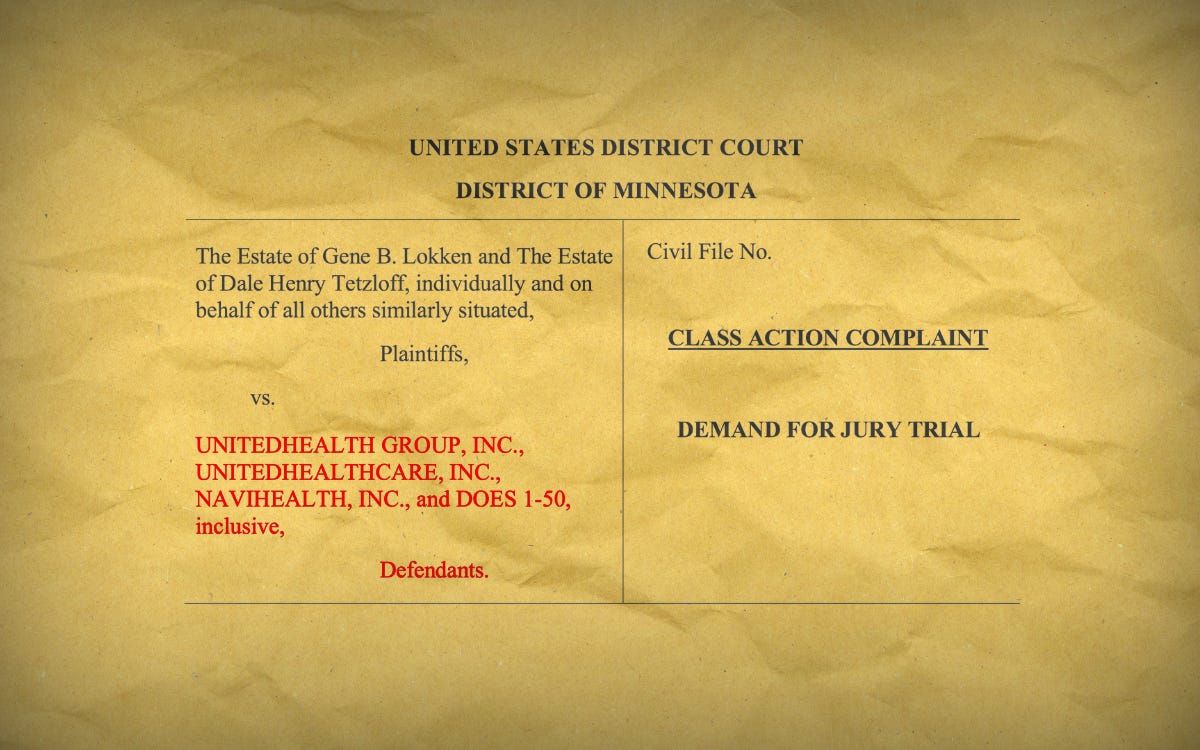
The case is Estate of Gene B. Lokken v. UnitedHealth Group, filed in federal court in Minnesota in November 2023. Gene Lokken was a 91-year-old Wisconsin man who fractured his leg and ankle in the spring of 2022. UnitedHealthcare covered his rehab for about 19 days before an algorithm determined he was done. His family disagreed and paid out of pocket for nearly a year of care until he died. He’s the lead plaintiff. A second family’s story anchors the suit alongside his.
Reports and lawsuits allege UnitedHealth uses AI algorithms to cut off care for the elderly and disabled

I’m writing this in my hotel room in Milwaukee where I will be speaking to a gathering of local business and community leaders later today about what they need to understand about Big Insurance.
The algorithm is called nH Predict, built by UnitedHealth’s subsidiary naviHealth, which the company bought for roughly $2.5 billion. It runs on a database of about six million patients. It compares a new patient against that pool and spits out how many days of care that person “should” need. The complaint alleges that the company understood a glaring asymmetry: roughly 90% of these denials were overturned when patients appealed, but only about 0.2% of patients ever appealed. That “90% error rate” everyone’s quoting comes from the lawsuit, which bases the figure on the share of challenged denials that were ultimately reversed. Those who didn’t appeal could be left paying out of pocket or going without continued care.
One of the most important details came from naviHealth’s own internal documents, which showed that the company set a 2023 target to keep patients’ rehab stays within 1% of the algorithm’s projected days. Staff who missed it risked discipline, no matter what the patient’s actual doctor said.
This isn’t one rogue algorithm
The case is bigger than UnitedHealth because the same nH Predict tool wasn’t United’s alone. NaviHealth also served Humana, the second-largest player in private Medicare. Humana now faces its own class action on nearly identical facts. Cigna is fighting a separate case over a system called PxDx that, according to the complaint, let Cigna’s doctors to deny claims in batches at about one a second. So three of the largest insurers in the country are defending algorithmic-denial suits at the same time.
As UnitedHealth and Cigna are Sued for AI-Based Claims Denials, Documents Suggest Major AI Expansion

In November 2023, UnitedHealth was sued for improperly denying claims using an artificial intelligence algorithm, nH Predict, that critics say has a 90% error rate. The result, which impacts patients with Medicare Advantage, was that people who needed care didn’t get it — or they had to pay exorbitant fees.
In 2023, Medicare Advantage insurers made nearly 50 million prior authorization determinations. That’s close to two for every enrollee. By contrast, traditional Medicare, where prior authorization is required for only a limited set of services, required fewer than fewer than 400,000 prior authorizations, roughly one review per hundred beneficiaries. The private plans denied 3.2 million requests. Only about 12% of those denials were ever appealed. Of the ones that were, more than 80% got overturned. And post-acute care (exactly where Lokken’s denial occurred) has emerged as a particular area of concern.
When federal investigators looked at denied skilled-nursing stays that patients bothered to appeal, about 95% were ultimately approved. For requests processed by naviHealth specifically, the reversal rate was even higher: Medicare Advantage plans overturned 97% of appealed denials.
When decisions tied to an algorithm are overturned that often and the errors overwhelmingly run in one direction (toward denying medically necessary care), it’s worth asking whether the problem is that the algorithm is broken or that it’s working as designed.
There’s also an uncomfortable connection to AARP, which licenses its name to UnitedHealthcare and collects a royalty on the Medicare plans that carry it. You don’t even need to leave your house to see this – just turn on your TV during open enrollment and you’ll see the ads. The most trusted brand to seniors in America is stamped on the same Medicare Advantage business now fighting a lawsuit over denials of the care those seniors were promised. More on that arrangement soon.
Where the case against UnitedHealth stands now
In February 2025, Judge John Tunheim let the breach-of-contract claims survive. He ruled, crucially, that federal preemption did not bar the plaintiffs’ claims that UnitedHealth breached its own contractual promises about how coverage decisions would be made, creating an opening that the parallel cases can now push through.
Washington Wants AI Regulation. It Should Start With Health Insurers.

As lawmakers develop a national artificial intelligence framework, health insurers are already using automated decision-making tools to influence Americans’ access to care.
The case moved further in March 2026, when a magistrate judge ordered UnitedHealth to turn over information about how nH Predict was built, whether it was designed to replace doctors, who sat on its internal AI Review Board, and what cost savings drove the naviHealth deal. Through the summer, the case moved toward class certification. The recent docket has consisted mostly of routine scheduling orders and a new answer from the company rather than the bombshell the social media posts earlier this month implied.
What’s at stake for UnitedHealth
If the court certifies a class, the case stops being about two families. It becomes about a potentially enormous class of Medicare Advantage members whose post-acute care was cut short. In the named cases alone, families paid around $220,000 out of pocket. Multiply that across a class, add bad-faith exposure, and the damages math turns serious.
A trial would put UnitedHealth’s own documents on how nH Predict was built, and why, into the public domain. And because Tunheim’s preemption ruling provides a potential path for similar contract claims, a win for the Lokken plaintiffs could have implications well beyond Minnesota. It would hand a roadmap to every lawyer suing an insurer over algorithmic denials.
Thanks for this.
One of my most significant experiences with AI is actually the voice-AI system that answers the phone at Fed Ex when you need a delivery rescheduled.
It's quite incredible how many hours I've wasted per delivery, as it keeps asking me the same question again and again, and hangs up on me when I ask it to speak to a person. (I figured out that if I give it ten tries, it will let me speak to a person, but it has to decide on its own that I need a person.)
It becomes clear that with AI, in the hands of people who either don't understand the limits of AI, or who are bent on saving money, a catastrophe is likely.
Not sure what they are stating they didn’t use Navitas Health to deny. Working in comercial auth for UHC, we nurses use to be pulled over to help with Medicare Advantage acute care auths and much to my surprise while reviewing an case of 80 year old complete independent at home suffered fall , had some cognitive and physical decline and therapy recommended SNF. I agreed and went to see if it had been requested. Lo and behold it had but to my surprise it was denied by a machine. And even more surprising there was no document as to why. Looking at the time - done in less than a minute. But yet the request met their Interqual guidelines . This was in 2024. She went home and fell down, broke her humerus.After that saw several instances of inappropriate denied admits. My neighbor had the same happen to him. Ankle fracture. I helped him with his initial phone call , showed him how he had met the criteria and than told them if the denial was machine assisted. They immediately told him to disregard the letter and that everything was good.