

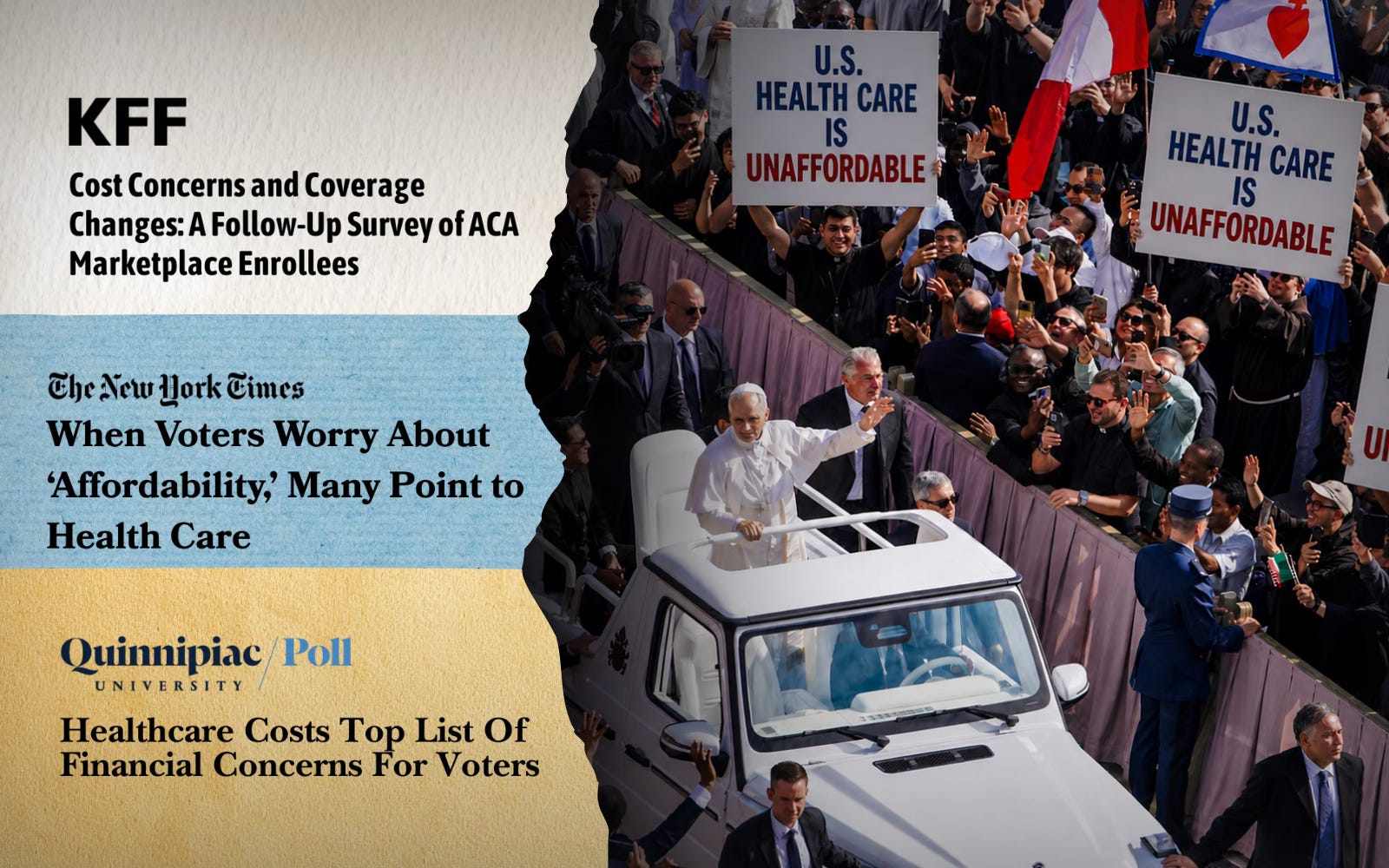
Pope Leo XIV (who became pope a year ago this week) isn’t just the first American pontiff—he’s also, as a Chicago native and Villanova University alum, the first leader of the Roman Catholic Church to have experienced the U.S. health care system firsthand. So it shouldn’t come as a surprise that this world spiritual leader born as Robert Prevost would use his lofty new platform to call for radical change.
“Health cannot be a luxury for the few,” Leo told a recent conference on health care inequality in Europe organized by both Catholic bishops and the World Health Organization, adding that good health care is essential for social peace.
“Universal health coverage is not merely a technical goal to be achieved; it is primarily a moral imperative for societies that wish to call themselves just,” the pope said. “health care must be accessible to the most vulnerable, then, not only because their dignity requires it but also to prevent injustice from becoming a cause of conflict.”
In less than a year on the job, the new pontiff has shown a lot of political savvy, and a knack for good timing. Leo’s endorsement of health care as a human right coincided with a couple of new, important U.S. surveys showing that both rising insurance premiums and high out-of-pocket medical bills have become the major driver of an affordability crisis that is hitting middle-class families hard.
To back this up, the leading health care non-profit KFF conducted a followup survey with more than 800 Americans who last year had been enrolled in Affordable Care Act (ACA) insurance in 2025. It found broadly that most have been struggling to pay medical bills since Congress failed late last to extend the federal subsidies that had made ACA coverage affordable for many in recent years.
WATCH NOW
In the third episode of the HEALTH CARE un-covered Show, we take a deep dive into prior authorization’s toll — from doctors to federal policy — featuring Dr. Wendy Dean, Dr. Seth Glickman and Rep. Suzan DelBene (D-WA) on CMS’s new AI-driven WISeR model.
Watch the full episode here.
Most of the respondents (80%) said they were paying more now for health care than in 2025, with just over half (51%) reporting they are now spending “a lot more.” For middle-class Americans, the critical need to stay healthy has meant cutting their budget for other essentials. KFF found that a majority (55%) were reducing spending on food or other household basics, but that jumped to 62% for people getting treatment for chronic disease.
Faced with drastically higher monthly premiums, KFF found, has forced these families to make difficult, consequential choices. Some 28% switched into a different ACA plan in an effort to hold down their monthly premiums – which means much higher deductibles and thus the risk of large out-of-pocket medical expenses. Even worse, some 9% told the KFF survey that they have dropped health insurance altogether, which means they are one accident or major illness away from a financial disaster.
A 34-year-old Texan who dropped his Obamacare coverage told the KFF pollsters that the sole reason was the cost. “The prices are simply too high,” he said. “$800 a month for the absolute cheapest plan for two people. Our income is $120k, so we don’t qualify for subsidies in Texas. I don’t think we could afford our mortgage if I had to pay for health insurance.”
Another respondent reported that his “Income exceeded the subsidy limit, forcing us to pay the full cost, so we switched down to a bronze from a gold plan. Even doing that our premiums are 3 times what they were in 2025, with lower plan features and a higher deductible.”
About 22% of the KFF respondents said they are still insured, but not through the ACA Marketplace. In some cases that is because they were able to switch to an employers’ health plan or because they were now eligible for Medicare and Medicaid. But others, KFF noted, switched into different types of high-deductible plans or a cost-sharing group – solutions that often lead to considerable out-of-pocket expenses.
One 56-year-old Texas man surveyed by KFF said that as a reaction to the higher insurance premiums he would “attempt to use health care as little as possible” – with the hope that by carefully consulting with his doctors and pharmacists he would avoid paying any out-of-pocket expenses that aren’t absolutely necessary.
The Pope is Right About CEO Compensation – Especially in the Health Insurance Industry

Last week, Pope Leo XIV made headlines when he called out the “continuously wider gap” between CEO salaries and working people. And you don’t have to look very far in the United States to find exorbitant CEO pay – especially in the health insurance industry.
Others offered more dire assessments. A 63-year-old California woman said that because of the premium hike she plans on “shopping for cheaper groceries, not buying clothes, avoiding getting sick, not being as social.” And yet things could get worse. Some 17% of the people surveyed said that while they’ve continued their insurance coverage for now, they’re not sure if they can afford to continue paying through the end of the year.
It’s important to note that this survey was conducted before the war in Iran began slamming the U.S. economy, with gasoline now at least $1 a gallon higher and ripple effects at supermarkets and elsewhere. As the November midterm elections draw closer, both candidates and experts agree that “affordability” remains the No. 1 issue on voters’ minds.
A recent Quinnipiac University national poll asked U.S. voters about their biggest financial concern from a menu of 11 possible choices. Health care was their top worry, and it wasn’t even close. Some 21% said that medical costs are now their biggest concern, way ahead of No. 2 (food shopping at 13%) as well as housing expenses and gasoline prices.
“When Voters Worry About ‘Affordability,’ Many Point to Health Care,” blared a recent headline on the New York Times website, heralding an article that said candidates in the 2026 primaries are increasingly finding that medical costs are the issues that voters want to talk about, and that public support is rising not only for a stronger ACA program but for more expansive options such as expanding Medicare to cover more Americans. The newspaper’s own poll, conducted with Siena College, also found that health costs were a No. 1 public concern, along with the high cost of housing.
“Health care costs are out of control,” Shawn Spencer, 48, of Greene County, Va., told the Times. “I don’t have insurance, so I’m paying a boatload when I need care.” And just imagine: If voters are this upset now, only three months into the end of the federal ACA subsidies, what will happen over the course of the year as more voters in Spencer’s situation become ill and face the possibility of medical bankruptcy.
In the KFF study, the overwhelming number of respondents believed – not surprisingly – that Congress made a mistake in not extending the ACA Marketplace subsidies that instead expired at year’s end amid typical Capitol Hill chaos and gridlock, Indeed, even 54% of those who reported that they are Donald Trump-supporting MAGA Republicans say that the legislation should have passed, even though it was GOP senators who ultimately blocked passage of the legislation.
As the public’s anger over health care costs grows, it’s hard to say which is more gobsmacking – that Republican lawmakers allowed the ACA affordability crisis to happen last year, or the fact that no one is racing to address the problem this year.
In January, the president released something he called “The Great health care Plan” which fit onto all of one page, raised a lot more questions than it answered, and had most experts agreeing that it wasn’t anywhere near great. Trump continues to push a system that would replace the ACA subsidies with a scheme to “send the money directly to the American people.” But there is no explanation of how that would work exactly, and outside experts say such a system would surely mean higher premiums for some people, especially those with preexisting medical conditions.
There is a silver lining in all of this, and it could prove to be a significant one by this time next year. The affordability crisis is emerging as a top campaign issue for Democratic candidates in their efforts to retake the House and possibly even the Senate – an outcome the polls are suggesting becomes more likely by the day. A House led by Democrats and a Senate with more Democrats would almost be certain to vote to restore the ACA subsidies (whether they’d face a Trump veto is uncertain) – and also push for more sweeping health care reforms. Given the progressive bent of some early primary winners, 2027 could also bring the first serious push in years for a more universal type system.
“[Health care] has to be an agenda,” Tom Periello, a former Virginia Democratic congressman who lost his seat in 2010 partly because of supporting the ACA and is now running to win it back. “You have to look at both sides. It’s getting costs down and getting paychecks up.”
In such an effort, Democrats would have the endorsement of Pope Leo, even if he is prone to couch the issue in spiritual terms. The pontiff said that “all men and women, especially Christians, are called to fix their gaze on those who suffer: on the pain of the lonely, on those who for various reasons are marginalized and considered ‘outcasts.’ For without them, we cannot build just societies founded on the human person.”
IMO The only way out is passing Medicare for ALL acts.
Thanks for caring.
Support for Medicare for ALL legislation in Congress among Democrats in both house and senate is growing!!!
S1506
HR 3069