

For a company that beat Wall Street’s earnings expectations, Elevance Health had a lot of explaining to do Wednesday morning.
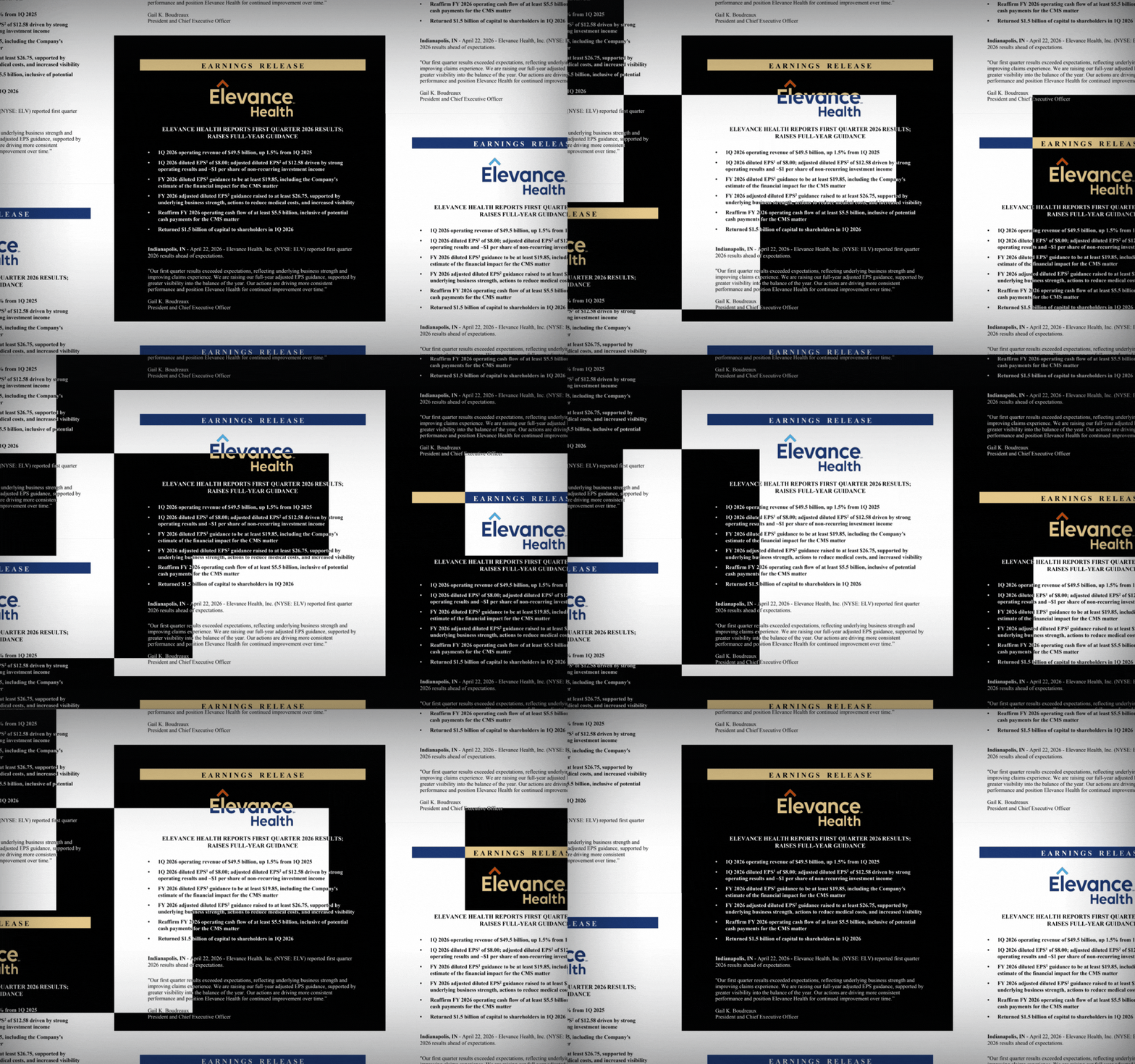
The Indianapolis-based insurer posted first-quarter adjusted earnings of $12.58 per share — above what analysts had expected — and raised its full-year guidance. CEO Gail Boudreaux called the results a sign of “underlying business strength and improving claims experience.”
But buried inside the same earnings release was a $935 million charge — the company’s “best estimate” of what it may owe the federal government for years of improper Medicare Advantage billing.
Here’s what happened, as documented in filings with the Securities and Exchange Commission and a February 27 notice from the Centers for Medicare & Medicaid Services:
Medicare Advantage insurers are paid by the government based on the health status of their members. Sicker patients generate higher “risk scores,” which generate higher payments. Insurers are required to submit accurate diagnosis data to CMS through its electronic systems — and if they discover that a diagnosis code isn’t supported by medical records, they’re required to correct it and return any overpayment within 60 days.
Elevance didn’t do that. According to CMS, from November 2018 through October 2025, the company submitted data corrections for unsupported diagnosis codes not through the required electronic systems but via encrypted external USB flash drives — a method CMS had explicitly rejected. During that same period, the company sent CMS seven letters stating it did not intend to use the required systems. CMS sent six letters directing it to comply.
The agency’s language was unambiguous: Elevance’s conduct represents “substantial and persistent noncompliance” that “has persisted for over seven years despite repeated clear directives from CMS.”
The result, as CMS sees it: Elevance collected government overpayments it never returned, and repeatedly certified the accuracy of its data submissions while knowing that unverified diagnosis codes had not been corrected through the required channels.
That is not a paperwork problem. That is a description of a company that — for seven years, across multiple administrations — chose to do things its own way with Medicare’s money.
Elevance’s CFO, Mark Kaye, pushed back in March, calling it “a broader policy and payments dispute about how retroactive corrections should be treated under the risk-adjustment framework.” The company revised its practices in April 2023 after additional regulatory guidance — nearly five years into the alleged noncompliance.
On Wednesday’s earnings call, Boudreaux reprised that framing, describing the matter as “historical payment disputes that involve the interpretation of the risk adjustment policy during that period in question” — and quickly added that it “is not about how we operate the business today.” She disclosed that CMS has extended the compliance deadline again, this time to July 31, and said the company believes that if it completes the required steps, “the sanctions will not go into effect.”
Nevertheless, in its Q1 earnings release, Elevance booked $935 million as its current best estimate of what it may owe — enough to drag GAAP earnings per share down to $8.00 from $12.58 on an adjusted basis, and enough to collapse GAAP operating income by more than a third year over year.
One day before Elevance reported, UnitedHealth Group — the country’s largest health insurer — posted its own first-quarter results. I was struck by how investors viewed the two companies’ first three months of 2026.
UnitedHealth reported $111.7 billion in revenue, adjusted EPS of $7.23 — beating Wall Street’s $6.57 consensus — and raised its full-year earnings guidance to more than $18.25 per share. Its medical loss ratio, the share of premium revenue spent on actual care, fell to 83.9%, nearly a full percentage point below the prior year and well below what analysts had forecast. Remember that investors applaud when the MLR declines because it means that the insurer spent less on its enrollees’ care than they did in the same quarter a year ago.
Elevance’s MLR came in at 86.8%, about three full percentage points higher than UnitedHealth’s. That gap reflects years of diverging performance in Medicare Advantage and Medicaid, two government programs that now define the financial trajectory of the biggest health insurance conglomerates.
Elevance’s Medicare Advantage membership fell 15.8% year over year — from 2.255 million members to 1.899 million. Medicaid membership dropped 4.6%. The company is deliberately shedding members it can’t make money covering. That’s not a growth strategy; that’s a retreat – and is consistent with the decisions made by the other MA giants: UnitedHealthcare, Humana and Aetna, which is part of CVS Health.
On Wednesday’s call, Boudreaux said what she knew investors would want to hear – and what I can’t imagine she would have said in a Congressional or state legislative hearing. On Medicaid, she said: “Where we don’t see a sustainable path to profitability in a state, we will exit.” That is the CEO of the nation’s fourth-largest Medicaid insurer telling investors, and indirectly telling state governments — and the low-income Americans depending on Medicaid — that coverage is contingent on acceptable profit margins. The people in those plans are not the constituency. The shareholders are.
UnitedHealth, for its part, is raising guidance and buying companies. It announced plans to acquire Alegeus Technologies this quarter and repurchase at least $2 billion of its own stock by the end of June.
What the Numbers Obscure
It’s worth reiterating that on Wall Street the metric that drives everything in this industry — the medical loss ratio — rewards companies that spend less on care.
When UnitedHealth’s MLR drops, Wall Street cheers.
Elevance’s higher ratio reflects, in part, genuinely elevated costs in Medicaid — a program serving low-income Americans in which state reimbursement rates can and frequently do lag actual medical inflation. On the Medicare Advantage front, the people losing Elevance MA coverage this year — roughly 356,000 of them — aren’t abstractions, either. They’re seniors who enrolled in privatized Medicare plans sold on promises of extra benefits, now caught in the crossfire of margin repositioning.
Back to that $935 million. That figure, if it holds, represents money Elevance collected from Medicare — funded by American taxpayers — for members whose diagnoses may not have been properly supported. Independent analysts at the Medicare Payment Advisory Commission estimate the federal government already overpays Medicare Advantage plans by tens of billions of dollars every year — $76 billion more in 2026 than it would cost to cover the same people under traditional Medicare.
Elevance’s situation is one data point in that larger pattern. It is not unique. It is, in fact, the predictable outcome of a system that pays private insurers more when their members appear sicker — and then relies on those same insurers to self-report when the data is wrong.
“Underlying Business Strength”
Elevance raised its full-year adjusted EPS guidance to at least $26.75. Shareholders got a $1.72 quarterly dividend and $1.1 billion in stock buybacks. And, like UnitedHealth’s executives, Boudreaux touted her company’s AI investments, claiming the technology is “reducing those denials by more than almost 70%.” That’s a striking assertion — prior authorization denials are one of the most documented sources of patient harm in American health care. If AI is genuinely reducing them, that matters. But the baseline and methodology behind that claim were not disclosed on the call, and given the source, some skepticism is warranted. Don’t hold your breath for Elevance to open its books for inspection to anyone who would like to see how real that number is.
Wall Street’s verdict on all of it was essentially a shrug. Elevance shares spent most of Wednesday oscillating between small gains and losses before closing up just five cents, at $328.16. Investors weren’t impressed enough to cheer, and weren’t alarmed enough to sell. The $935 million CMS liability — representing seven years of improper Medicare billing — appears to have been fully absorbed into the stock price already, treated as a one-time charge to be moved past rather than a signal about how the company has operated.
The more telling market reaction may have come from UnitedHealth. Despite reporting its own results the day before, UNH shares rose $7.41, or 2.14%, on Wednesday — apparently buoyed by Elevance’s relatively stable quarter, which reassured investors that the sector’s cost pressures seem manageable. The country’s largest health insurer gained more on Elevance’s earnings day than Elevance itself did. That is Wall Street’s logic at work: in an industry where the underlying dysfunction is priced in, good enough is plenty.
Charge them with RICO Act
With all the shenanigans these companies foist on the taxpayers, the administration continues to advocate more Medicare beneficiaries be lured into Medicare Advantage. Go figure.
This article reminds me of an observation I made quite some time ago: When the quality metrics for one of these companies failed to meet standards, the investors didn't respond. When the MLR missed targets, the stock plummeted. It taught me that I was wrong to hope that the market gave a damn about the way the company in question provided coverage for it's insureds. It was all about "show me the money." Nothing has changed since that observation.