

The letter arrived with less than a month’s warning. In early 2026, patients of Red Oak Counseling in Milwaukee learned that their clinic, downtown and in Elm Grove, would close on February 25. One patient, receiving a specialized, insurance-covered treatment for depression, learned the same care elsewhere would cost roughly $2,400 a month. The notice offered no transition plan, only a suggestion to search an online therapist directory. “I wasn’t expecting this closure whatsoever,” she told a local TV station. When reporters asked why, staff pointed them to corporate ownership: Optum.
Red Oak is not unusual. It is part of a pattern: the quiet unwinding of behavioral-health practices that UnitedHealth’s Optum acquired only a few years earlier, often with the same abrupt letter, the same generic referral, and the same corporate statement about making care “more affordable.”
The Sunlight Report
Our prior report documented how vast UnitedHealth Group’s enterprise has become, with thousands of controlled entities spanning insurance, pharmacy, and, increasingly, the delivery of care itself. Optum is now the largest employer of physicians in the country.
The Sunlight Report on UnitedHealth Group

The Sunlight Report on UnitedHealth Group is a first-of-its-kind look at the nearly 2,700 subsidiaries that make up UnitedHealth Group, the largest health care conglomerate in the world.
While the report answered how big, an equally important question is what happens to the clinical assets they acquire. The question matters most in behavioral health, where care access is severely strained by provider shortages, exorbitant out-of-pocket costs, and insurance network limitations. In the U.S., the average wait time to see a psychiatrist is 67 days with nearly 6 in 10 psychologists having no openings for new patients. Preserving in-person access is therefore critical.
Our latest findings
Using UnitedHealth’s annual National Association of Insurance Commissioner (NAIC) Schedule Y filings, we tracked each behavioral-health practice the company acquired from 2011 through 2025 and determined whether they were still seeing patients in person, converted to virtual-only, or closed.
Behavioral health entered UnitedHealth’s orbit almost overnight. In 2022, Optum bought Refresh Mental Health, a private-equity roll-up of more than 300 outpatient locations across 37 states, from Kelso & Company. Within roughly three years, a striking share of that footprint was gone or transformed.
Senate Hearing Focuses On the Sunlight Report on UnitedHealth Group

This week, I presented the Sunlight Report on UnitedHealth Group's findings to the U.S. Senate Health, Education, Labor, and Pensions (HELP) Committee.
Overall, we found that over one-half of outpatient behavioral-health entities UnitedHealth Group acquired, 53% (37 of 70), have closed entirely or closed at least one office (Figure 1). Because a single entity (defined by a unique federal employee identification number) may operate multiple physical locations, this translates to 50% (108 of 216) of the sample’s individual practice locations closing their doors. Closures spanned 21 states, concentrated in New Jersey (21 offices), Illinois (19), Arkansas (13), California (10), Wisconsin (9), Washington (6), Indiana (5), Rhode Island (5), Tennessee (4), and Kentucky (3).
The losses cluster in revealing ways:
Eating-disorder wipeout. In early 2024, Optum shut its in-person eating-disorder facilities, including Fairhaven Treatment Clinic, the only facility in Memphis dedicated solely to eating disorders, and for many patients on Medicaid, one of the only insurance-covered options. Patients called these centers “lifelines” in a petition to keep them open. That wasn’t hyperbole for a condition with one of the highest mortality rates of any mental illness.
A whole state. In November 2025, Optum ended all behavioral-health services in New Jersey, part of a contraction that closed roughly 90 offices and cut 572 jobs.
Specialized care disappears. In Columbus, Optum shut down Amigo Family Counseling, terminating its staff and ending services to its autistic clientele, a practice whose clients and work inspired the Broadway musical How to Dance in Ohio.
Not every entity that disappears from a filing is a shuttered clinic; much of the churn is internal corporate reorganization while care continues. The 53% figure counts only entities that we had confirmed closed or shrunk their physical footprint. Some clinics that remained open also reduced staff or shifted patients toward virtual care. Importantly, Schedule Y lists legal entities rather than individual clinic locations, and a single entity may operate many offices that are not separately reported; our results therefore likely understate the number of physical sites affected.
The money tells a different story than the mission
Follow the behavioral-health dollars and the pattern is hard to miss. In 2022, Optum paid more than $1 billion for Refresh Mental Health — a network of more than 300 in-person therapy and psychiatry offices it has since been closing — and a reported $470 million for the virtual-therapy company AbleTo two years earlier.
Meanwhile, through its venture arm, Optum Ventures (over $2 billion across six funds and 75-plus companies) has backed a roster of behavioral-health startups that is almost uniformly virtual, digital, or data-driven: Nema Health (virtual PTSD care), BehaVR (VR-based digital therapeutics), tele-behavioral counseling platforms, and Holmusk, whose NeuroBlu platform turns real-world behavioral-health data into a commercial product.
The logic is not mysterious. Capped by medical-loss-ratio rules from growing insurance margins, the company grows by owning services and data instead. Capital flows toward scalable, remote, data-generating services, while the labor-intensive, in-person clinics that patients depend on are closed in the name of “affordability,” a word that describes the company’s costs, not the patient’s.
Optum has not published data showing that its virtual investments offset these community closures. And for people who depend on care in their community, there is no replacement: those with serious mental illness, eating disorders, and patients like the woman in Milwaukee, whose treatment can only be given in a clinic on a consistent schedule. The digital divide compounds this. Black, Latino, older, and rural patients are reached least by video telehealth, leaving them the most exposed when in-person care abruptly converts to virtual.
We also identified several other patterns:
The records leave town. When these practices close, patients are routed to a virtual entity and told that a professional corporation (frequently “Optum Behavioral Care of Colorado, P.C.”) is now the custodian of their mental-health records, regardless of what state they live in. Consolidating behavioral-health and substance-use records into out-of-state shells raises important privacy questions.
Closures without continuity: The practice closures reviewed here share a pattern: little notice, a generic letter, no warm handoff, and referral to a directory rather than a named provider. In behavioral health, where the therapeutic relationship itself is part of the treatment, an abrupt cutoff runs against established guidance on continuity of care and planned termination (see patient comments in Figure 3).
What policymakers should do
This pattern is largely invisible. Several steps would change that:
Make it transparent. Insurers that own care delivery assets should have to disclose closures, conversions, and ownership changes, reporting clinic locations (not only the legal entities named in NAIC filings) on an ongoing basis in a clear and transparent manner, so communities and regulators aren’t left reconstructing them from corporate filings well after the fact.
Scrutinize the deals and promises. State and federal reviewers approving insurer acquisitions of care providers should weigh community access and require and enforce commitments to keep acquired practices operating locally for a defined period at specified staffing levels.
Require continuity-of-care standards. Closures of clinical practices should trigger minimum patient-notice periods and active transfer of care (not directory referrals), consistent with professional society guidelines. There also needs to be robust oversight of compliance with state and federal confidentiality laws and heightened protections for behavioral-health and substance-use records.
Don’t let “virtual” conceal real-world network gaps. Medicare Advantage gives telehealth credit toward network standards (42 CFR 422.116(d)(5)), now extended to outpatient behavioral health. The rules should be updated so that telehealth is not a replacement for behavioral health care delivered in the community where people live.
Count the local cost. Reviews of potential transactions should account for workforce and economic impact, and the downstream burden on emergency rooms and safety-net providers when outpatient options vanish.
The stakes
We don’t know what happened to the woman in Milwaukee after her care was cut off. Multiply her experience across the practices closed in California, Tennessee, Ohio, New Jersey, Wisconsin, and beyond, and a picture emerges: a health-care giant that bought its way into behavioral health, then quietly walked much of it back, leaving patients to find the exit on their own.
Figure 1. Outpatient behavioral health care closures
(Note: An entity has one or more practice locations)
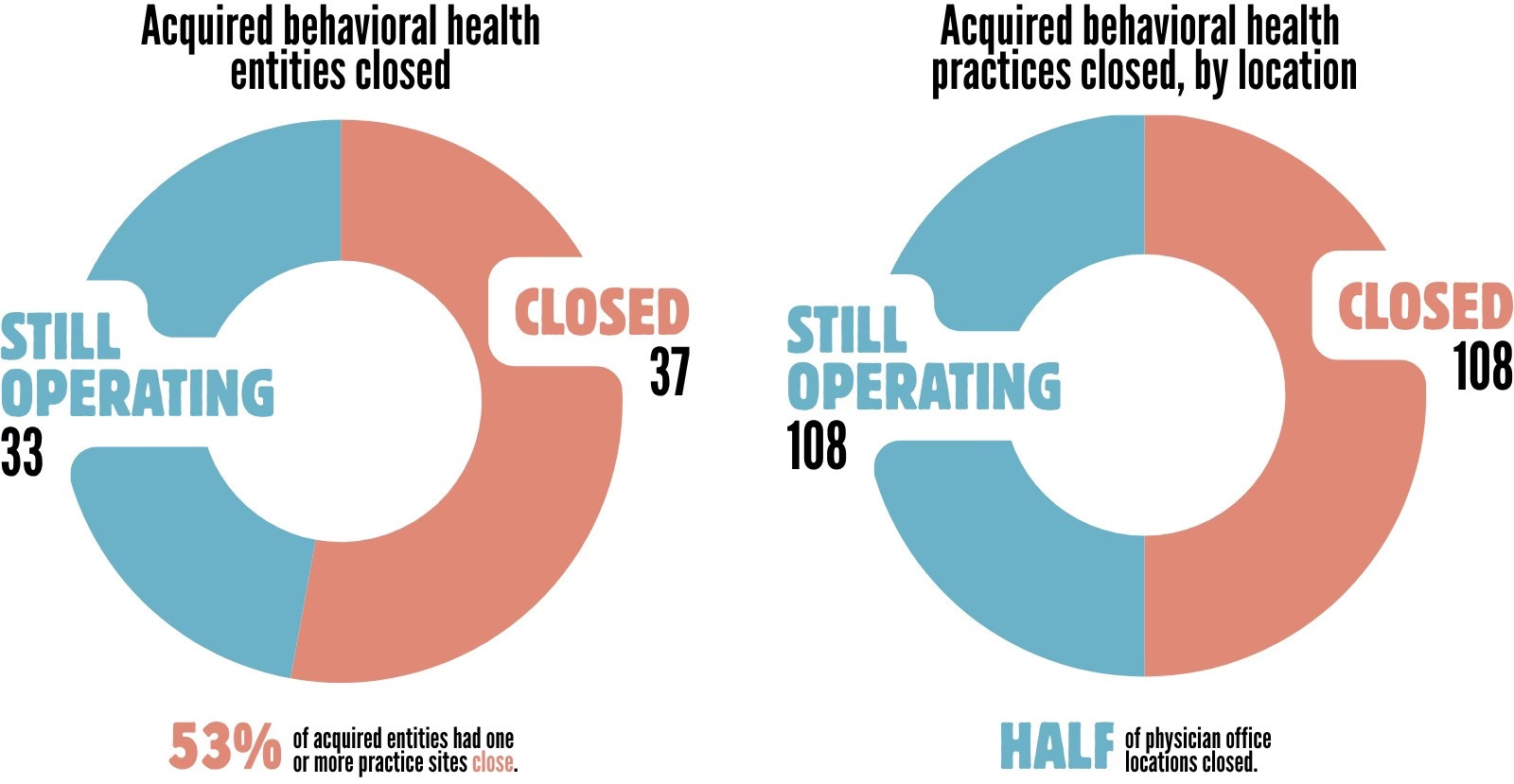
*Information and analyses contained herein were compiled by the author from publicly available sources, including UnitedHealth Group NAIC Schedule Y filings (2011–2025), NPI Registry searches, press releases, and news reporting. Public disclosure is incomplete and sources at times conflict on dates, entity names, and corporate relationships; where they do, entries reflect the author’s interpretation of the best available evidence. This figure is not intended to be definitive and may not capture all relevant transactions.
Figure 2. Closures by state
Outpatient behavioral-health entities in UnitedHealth Group NAIC Schedule Y filings having one or more outpatient locations close post-acquisition. Number in parentheses = physical locations closed for that entity.
Figure 3. The human cost
What Optum’s behavioral-health closures meant for patients
MILWAUKEE, WISCONSIN
An abrupt closure with limited support.
“...a careless, generic letter with no thought of any treatment plan of care transfer, nothing.”
Katie Bloom, patient, Red Oak Counseling
“I wasn’t expecting this closure whatsoever, and it’s really disheartening.”
Adriana Corbell, patient
TMJ4 News · February 2026
MEMPHIS, TENNESSEE
Memphis’s only center dedicated solely to eating disorders; a Medicaid safety net.
“People are getting hurt by this. People are not getting access to this type of treatment.”
Heather, 22, patient, Fairhaven Treatment Center
“These treatment centers are not just buildings; they are lifelines.”
Patient petition to keep the centers open
WREG Memphis; Change.org petition · 2024
NEW JERSEY — STATEWIDE
All behavioral health ended statewide: roughly 20 offices closed, 572 jobs cut.
“It’s disappointing to only be given kind of like a week’s notice to try to figure it all out.”
An Optum patient, New Jersey
“I don’t think we should have to go out of town to find medical care.”
Niki Westra, parent, New Jersey
CBS New York · November 2025
Seth Glickman, MD, is a former insurance and health system senior executive. He now is a researcher and advocate for reform in the health care finance space.
This hoarding and monetizing of health data explains why the State Department is demanding access to health data from other nations before said nation can get any public health assistance, according to NPR.
Aside from affordability, which affects us in the here and now, I really do fear where this all goes.
I'm not on topic here, but I caught a Wa Po Editorial this morning attempting to further undermine the health insurance system, holding on to, and then extending, the ACA and other cuts that the Democrats tried unsuccessfully to stop with the shutdown at the end of last year.
THE 7/15/26 WASHINGTON POST EDITORIAL
entitled
“Medicaid Fraud Control Units aren’t doing enough to control fraud Indictments and convictions are down, despite a surge in funding. July 14, 2026 at 1:26 p.m. EDT”
and is here:
https://www.washingtonpost.com/opinions/2026/07/14/medicaid-fraud-control-units-arent-doing-enough-control-fraud/ .
(NOT to be mixed up with the 7/10/26 Washington Post Editorial, which I find so problematic I have a full POST on it:
https://normspier828307.substack.com/p/washington-post-editorial-71026-i )
O.K. Fraud. Fraud with the ACA, and its associated “expanded Medicaid”, which is actually part of the ACA legislation, and did not exist prior to it. And everywhere else they want to shout about it—”fraud, fraud, fraud!”.
(Prior instances have been explored, and found false, exaggerated, falling short, vacuous, curious, etc. etc.
Such as the “phantoms”, which they had to switch to “ghosts” because they figured too many of those targeted didn’t know what the word “phantom” means:
https://substack.com/@normspier828307/note/c-288953391
Then you’ve got Dr. Oz, with his four wild deceptions, on the National Mall, as part of the new “Let Them Eat Pancakes” campaign:
https://substack.com/@normspier828307/note/c-289373653
Then you’ve got the huge and increasing coverage number drops are supposed to all be from stopping the fraud. (Baloney:
https://normspier828307.substack.com/p/the-administrations-claim-in-the
Then you’ve got the earlier leak from CMS that the false due-to-fraud explanation was coming
https://normspier828307.substack.com/p/loss-of-aca-coverage-after-republicans
)
WOULD I GET TO THE POINT?— THE CURRENT 7/15/26 WA PO EDITORIAL!
OK, I will.
The editorial continues in the logically vacuous style of the prior one, apparently attempting to have people just see “ACA—FRAUD—BAD—STUPID DEMOCRATS WHO LET EVERYONE CHEAT”, which a certain class of minds take as equivalent to airtight reasoning.
So, that approach seems to be most evident at the very end, with, in the last paragraph:
“Targeting waste and abuse is necessary but not sufficient to save Medicaid, whose costs have ballooned in unsustainable ways because of the Affordable Care Act.”
This may need an explainer—as to why Medicaid costs have gone up—”ballooned in unsustainable ways” is, of course, wording chosen for the benefit of those who get mixed up between words and actual content):
Medicaid costs have gone up quite a bit with the Affordable Care Act, because a new part of Medicaid was added, expanded Medicaid.
Expanded Medicaid is part of the ACA, and covers about 20 million people now. It is the way people without other health coverage, such as from an employer, who are below 138% of the Federal Poverty Level (FPL), get coverage. (There is no asset test—people below 138% of FPL get it regardless of assets—done to make the system airtight and leave no one out.) So, they get expanded Medicaid. (Without the expanded Medicaid, they would not have coverage unless they dropped down to being dirt poor in BOTH income and assets to qualify for traditional, pre-ACA Medicaid, which still exists.) The expanded Medicaid people cannot get subsidized on-exchange coverage, as the ACA structure prohibits them from doing that. This provision of the ACA was done as a cost-saving measure, to keep the lower-income group getting services paid for by the government at the lower Medicaid reimbursement rates.)
—-
Beyond the “fraud” and “ballooned in unsustainable ways” wording to manipulate the less-analytically-discerning, which is the apparent purpose of the editorial,
NOTE THESE:
BIG ONE, in the quoted text: “but not sufficient”!!!
More fully: “Targeting waste and abuse is necessary but not sufficient”.
Do you see that? Thinking caps, the logically capable. Those cuts from OBBB. (Not in effect yet. They go into effect right after the midterms. Coming. Sure to bring chaos and uninsurance to many.)
Begging the question here on “not sufficient” (in the old fashioned logic meaning—not the newer “raises the question” sense.)
Also:
We don’t see much in dollar amounts of the fraud. Keeping dollar amounts out of perspective is a repeated technique of these guys. A millions, a billion, a trillion—what’s the difference—they all rhyme, after all?
So, note total federal spending on health care is about $1.9 trillion a year. That would be 1,900 billion. (From https://www.kff.org/medicaid/what-does-the-federal-government-spend-on-health-care/ )
Meanwhile, I don’t see any dollar amounts in this thing: https://thefga.org/research/americas-medicaid-fraud-control-units-are-failing-their-mission/ that the Wa Po editorial refrenced from this “Foundation for Government Accountability” think tank that they reference.
They also seem to have left off a comparator, that tax evasion in the U.S. is about $700 billion a year https://siepr.stanford.edu/news/mapping-maze-where-irs-could-find-billions-unpaid-taxes
and I don’t have a number on loopholes, which would be separate. And I wonder how much the administration is doing about that. (It would be Scott Bessant, not Dr. Oz.)